 Astrolinks


Short answer
As of November 2026, a full-time Filipino virtual assistant typically costs a few hundred to around a thousand US dollars a month, with one staffing firm's data showing a median ask of about US$714. US virtual assistants averaged about $23 an hour in Indeed job postings. Also budget for hiring and payment fees, software, bonuses and your own training time.
Astrolinks gives each person a daily report written from their own private log. No screenshots. Get it free →
"How much does a virtual assistant cost?" sounds like it should have a one-line answer. It doesn't, because the price swings a lot depending on where the VA lives, what they do and how you hire them. And the hourly rate is only part of what you'll actually pay.
This guide gives you the real numbers for 2026, with sources and dates, plus the costs most "VA pricing" pages leave out: hiring fees, payment fees, software, bonuses and your own time. At the end there's a worked yearly budget for a full-time VA you can adapt.
It's written for agency and small business owners deciding whether to hire, and where.
How much does a virtual assistant cost by country?
We only list figures we could check at the source, all checked in November 2026.
| Market | Figure | Source and what it measures |
|---|---|---|
| Philippines | Average ₱27,526 a month | Indeed Philippines: about 1,100 salaries from job postings, including local employers, updated 8 Nov 2026 |
| Philippines | Median ask US$714 a month (middle half US$571 to US$900) | Armasourcing, via Outsource Accelerator: what 1,385 Filipino applicants asked for in full-time remote roles for foreign clients, Oct 2025 to Jul 2026 |
| United States | Average $23.23 an hour (range shown $13.66 to $39.52) | Indeed United States: 498 salaries from job postings, updated 5 Nov 2026 |
How to read these:
- For a foreign client hiring a Filipino VA directly, the US$714 a month figure is the closer guide. The Indeed Philippines average includes local jobs, which usually pay less than remote roles for overseas clients.
- US figures are mostly employee pay. If you hire a US VA as an employee, add employer taxes and any benefits. If you hire a US freelancer, expect a higher hourly rate, since they cover their own costs.
- Skills move the price more than anything. General admin and data entry sit at the low end. Bookkeeping, paid ads, ecommerce operations, executive support and development cost more.
We cover the same data from the VA's side, and what affects their rates, in how much to charge as a virtual assistant.
Should you pay a virtual assistant hourly or monthly?
VAs are usually paid in one of three ways:
- Hourly. Simple and flexible, good for part-time or uneven work. You'll want a reliable record of hours, ideally split by client if you resell their time.
- Monthly, full-time or part-time. Common for Filipino VAs working for one main client. Predictable for both sides. A full-time month is usually around 160 to 175 hours.
- Retainer or package. A set number of hours or tasks per month for a fixed price. Common with US freelancers and VA agencies.
For a rough comparison: US$714 a month for about 173 hours (40 hours a week) works out to roughly $4 an hour. That's why many agencies build their team in the Philippines, and why the best Filipino VAs can be choosy about clients.
How much does a part-time virtual assistant cost?
Many small businesses start at 10 to 20 hours a week. Scaling the figures above gives a rough starting point, not a quote:
| Hours a week | About hours a month | Filipino VA, scaled from the US$714 median | US VA at $23.23 an hour |
|---|---|---|---|
| 10 | 43 | about $180 | about $1,000 |
| 20 | 87 | about $360 | about $2,000 |
| 40 (full-time) | 173 | $714 | about $4,000 |
Treat the Filipino column as a floor. Rates vary a lot by skills and experience, and some VAs charge more per hour for part-time work because it's less predictable for them than one full-time client. Ask candidates for their rate at the hours you actually need, and confirm whether it's hourly or a fixed monthly amount.
Direct hire vs agency: what's the difference in cost?
| Hire directly | Through a VA agency or staffing firm | |
|---|---|---|
| Cost | Lower: you pay the VA, plus a job board fee | Higher: the agency adds its margin, often a markup on the VA's pay |
| Your time | More: you write the post, screen, test and onboard | Less: they recruit and screen, some also train and manage |
| If the VA leaves | You start again | They usually find a replacement |
| Relationship | Direct with the VA | Through the agency |
Neither is right for everyone. If time is your scarcest resource, an agency can be worth it. If you can spend a few hours hiring well, direct is cheaper over a year. Our step-by-step guide on how to hire a Filipino virtual assistant covers the direct route.

The hidden costs of hiring a virtual assistant
Pay is the biggest cost, but not the only one. Budget for these too:
- Hiring fees. Job boards like OnlineJobs.ph charge employers a monthly fee to contact applicants; as of November 2026, its paid plans started at $69 a month (their pricing). Freelance marketplaces like Upwork charge fees on payments instead.
- Paid test tasks. One to two hours each for your top two or three candidates. Small, but worth budgeting.
- Payment fees. Sending money abroad costs something, through transfer fees, exchange rate margins or both. Services like Wise are usually cheaper than PayPal. Agree who pays them.
- Software seats. Chat, task manager, password manager, maybe a time tracker or daily report tool. Many have free tiers for small teams, but paid seats add up.
- Bonuses and paid holidays. Many clients of Filipino VAs pay a 13th month bonus in December and give paid time off for major holidays. It's expected by many workers, and good VAs remember who pays it.
- Equipment allowance. Some clients help with a backup internet connection or power supply, because outages cost both sides.
- Your time. Expect to spend several hours a week in the first month on onboarding, feedback and answering questions. It drops sharply once they're up to speed.
- Turnover. The biggest hidden cost. Losing a trained VA and hiring again can cost a month or more of lost productivity. Fair pay, on-time payment and respect are the cheapest retention plan.
A worked yearly budget for a full-time Filipino VA
Here's a simple example, using the median figure above. Swap in your own numbers.
| Item | Yearly cost (US$) |
|---|---|
| Pay: $714 a month × 12 | 8,568 |
| 13th month bonus (one extra month) | 714 |
| One month of a job board plan to hire | 69 |
| Paid test tasks for 3 candidates (2 hours each at about $5) | 30 |
| Payment fees (varies by method; estimate yours) | ~100 to 300 |
| Software seats (varies a lot; many free tiers) | ~0 to 600 |
| Total | about $9,500 to $10,300 |
Compared with a US VA at $23.23 an hour for 40 hours a week, about $48,300 a year before employer costs, the difference is large. But the real question isn't only price. It's whether the person can do the work well, and whether you can see that they did.
Is a virtual assistant worth the cost?
A quick way to check, before you hire:
- Count the hours. List the tasks you'd hand off and how long each takes you in a normal week.
- Decide what you'd do instead. Client work, sales, or simply not working evenings. Be honest; not every freed hour turns into money.
- Compare the two. For example, say you hand off 15 hours a week, about 65 hours a month. If even a third of that becomes client work you bill at $75 an hour, that's about $1,600 a month, against roughly $800 to $860 a month all in for the full-time Filipino VA budgeted above.
Two things change the answer. First, the first month or two pays back less, because you're training. Second, the maths only works if the tasks are clear and repeatable; see what to delegate to a virtual assistant first. If you can't yet list 10 hours a week of handoff work, start part-time.
How do you get your money's worth from a VA?
The money on a VA is well spent when the work is clear, and wasted when it isn't. A few habits make the difference:
- Hire for a specific role. Write the tasks and tools down before you post a job.
- Onboard in writing. Instructions, examples and logins on day one. Our virtual assistant onboarding checklist helps.
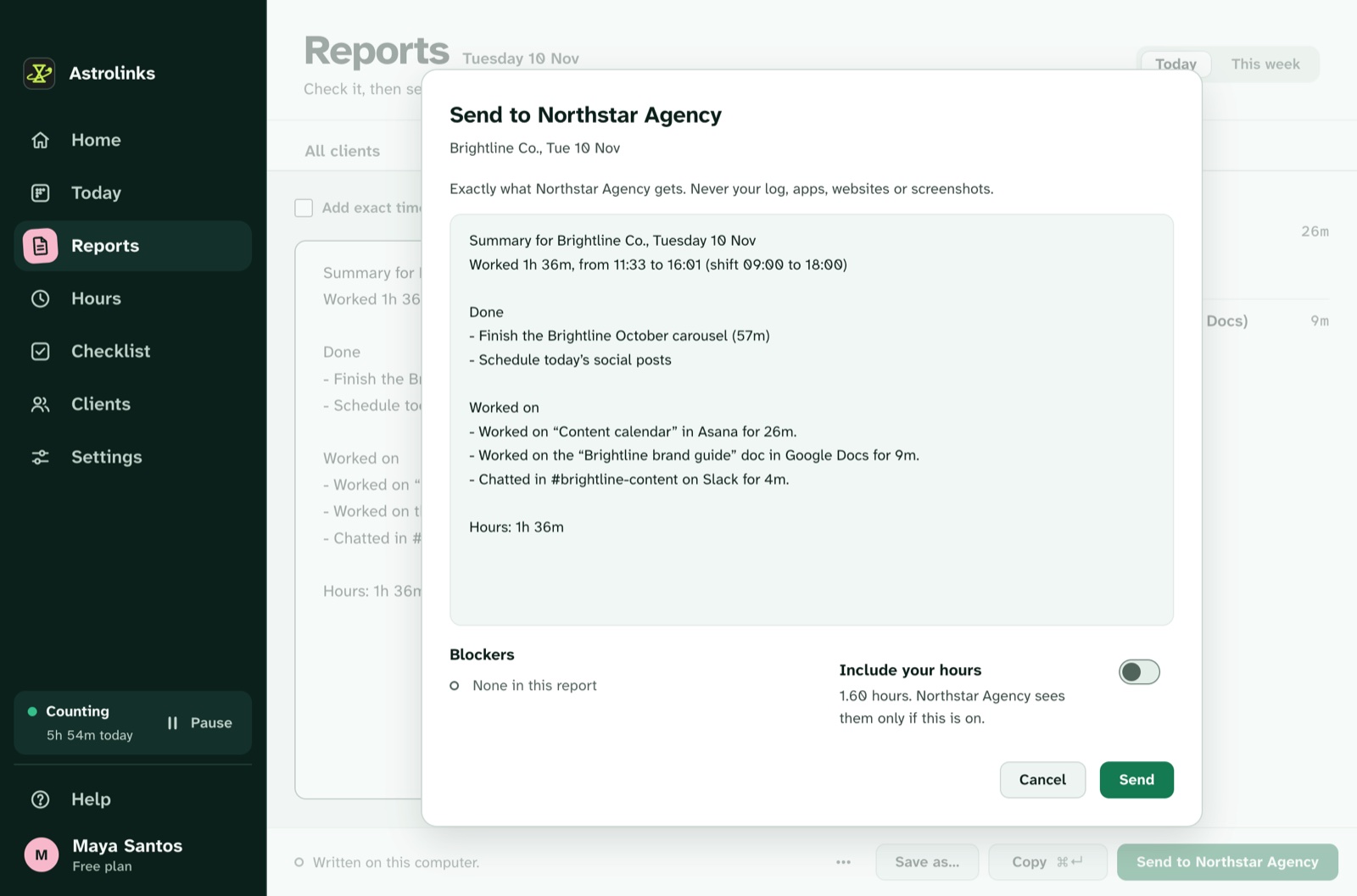
- Ask for a short daily update. Done, next, blocked, at the end of each shift. It's the simplest way to see what you're paying for, without screenshot software. See how to know if remote employees are working.
- Answer blockers fast. A VA waiting a day for a login is a paid day lost.
- Review pay once a year. Replacing a good VA costs far more than a raise.
Where Astrolinks fits
We make Astrolinks, so read this with that in mind. Astrolinks is a desktop app for Mac and Windows that helps you see what you're paying for. It keeps a private log of your VA's workday on their own computer, sorted by client, and drafts their end-of-day report at clock-out. They check it and send it. On the Team plan, reports from all your VAs land in one inbox, split by client, ready to forward. It also tracks hours by client, which helps if you bill clients for VA time. No screenshots and no keystroke logging.
If you run an agency with remote staff, we're running free 14-day pilots for up to 5 people, no card needed. Ask for a pilot or read about Astrolinks for agencies.
The short version
A full-time Filipino VA costs roughly US$700 a month in pay as of November 2026, or about $9,500 to $10,300 a year once you add a 13th month bonus, hiring and payment fees, and software. A US VA averages about $23 an hour in job postings, around $48,000 a year full-time before employer costs. Agencies cost more but save your time. Whatever you pay, you get the most from it with a clear role, proper onboarding and a short daily update that shows what got done.