 Astrolinks


Short answer
Work out how much to charge as a virtual assistant from three things: the income you need, the hours you can really bill, and what clients pay for your service. Add 25 to 40 percent for unpaid admin, tools and taxes, then pick hourly, a monthly retainer or fixed packages. Check your number against current job post data.
Astrolinks writes each client’s end-of-day update from your actual work, so 6 pm isn’t report time. Get it free →
"How much should I charge?" is the question every new virtual assistant asks, and the honest answer is that there isn't one number. A VA in Manila supporting a US real estate team, a VA in Ohio doing bookkeeping admin and a beginner doing data entry are in different markets. What you can do is build a rate from your own numbers, then check it against real pay data.
This guide covers both: a simple formula, the three common ways VAs price their work, and the current salary data we could verify for the Philippines and the United States, with sources and dates.
What do virtual assistants earn right now?
We only list figures we could check at the source. All were checked on 19 November 2026.
| Source | Market | Figure | What it measures |
|---|---|---|---|
| Indeed Philippines | Philippines | Average ₱27,526 per month | About 1,100 salaries from job postings on Indeed in the past 36 months, updated 8 Nov 2026 |
| Armasourcing, via Outsource Accelerator | Philippines | Median request US$714 per month (about ₱40,000); middle half US$571 to US$900 | What 1,385 Filipino applicants asked for in full-time remote VA roles, Oct 2025 to Jul 2026, from one staffing firm's records. Published 17 Aug 2026, updated 29 Oct 2026 |
| Indeed United States | United States | Average $23.23 per hour; range shown $13.66 to $39.52 | 498 salaries from job postings on Indeed in the past 36 months, updated 5 Nov 2026 |
Three things to keep in mind when you read these:
- They are mostly employee pay, not freelance rates. A job posting salary assumes the employer covers some costs. As a freelancer you pay for your own internet, equipment, software, unpaid admin time and taxes, so your rate has to be higher than a salary for the same hours.
- The Philippine figures measure different things. Indeed's average comes from what employers post, including local companies. The Armasourcing figure is what applicants asked for in remote roles for foreign clients. That explains much of the gap.
- Averages hide a wide spread. Specialist work, such as bookkeeping, ecommerce operations or real estate support, usually pays above general admin.
How much do virtual assistants earn in the Philippines?
For Filipino VAs, the two sources above give a useful frame as of November 2026: around ₱27,500 a month on average in Indeed job postings, and a median ask of about US$714 a month among applicants for full-time remote roles at one staffing firm.
What moves you up or down that range:
- Who you work for. Direct foreign clients usually pay more than local employers or agencies, because the agency keeps a share.
- What you do. Admin and data entry sit lower. Bookkeeping, ecommerce store management, paid ads, executive support and medical or real estate VA roles tend to sit higher.
- Your hours. A night shift that matches a US business day is often part of the price, and many clients expect it.
- Proof. Testimonials, a portfolio and a track record with one or two clients do more for your rate than certificates.
If you work for overseas clients, quote in their currency, usually US dollars, so they never have to convert. We wrote more about working this way on our page for virtual assistants in the Philippines.
How do you calculate your VA rate?
Use your own numbers, not someone else's average. Here is the formula, with an illustration you should replace with your figures:
- Pick your monthly target income. What you need to live on, plus savings. Say US$1,000.
- Add your costs. Internet, a backup connection, software, equipment and any platform or payment fees. Say US$100 a month.
- Add a buffer for taxes and unpaid time. Most freelancers set aside 25 to 40 percent on top. Your local tax rules decide the right figure, so check them. Here, 30 percent of US$1,100 is US$330.
- Count the hours you can really bill. Not the hours you work. Admin, proposals, learning and messages are unpaid. If you work 40 hours a week but bill 30, that's about 130 billable hours a month.
- Divide. US$1,430 ÷ 130 hours = US$11 an hour, rounded.
That's your floor: the lowest rate that meets your needs. Then compare it with what clients in your niche offer. If the market pays more, charge more. If the market pays less, either niche up into better-paid work or find clients in a market that values it.
Which pricing model should a VA use?
Most VAs use one of three models. Many use two at once, for different clients.
Hourly
You charge for each hour worked and send a timesheet with the invoice.
- Good for: new clients, unpredictable work, short trial periods.
- Watch out for: clients asking for hour-by-hour detail, and the fact that getting faster earns you less.
- Tip: Set a minimum, such as 10 hours a month, so small clients are worth the admin.
Monthly retainer
The client pays a fixed amount each month for a set number of hours, such as 80 hours. Unused hours usually don't roll over, and extra hours are billed at your hourly rate.
- Good for: steady clients and steady income.
- Watch out for: scope creep. Write down what the retainer covers and what happens when the client goes over.
- Tip: Retainers are often priced a little below your hourly rate in exchange for commitment. Decide that discount on purpose, if you give one at all.
Packages and fixed prices
You charge a set price for a defined result: "inbox cleanup and filing system," "30 social posts a month," "monthly bookkeeping for up to 100 transactions."
- Good for: repeatable work you can do faster over time. Speed becomes your profit, not your loss.
- Watch out for: vague packages. List exactly what's included and what's not.
- Tip: Time yourself on the work for a month at hourly rates first, so you price the package from real numbers.
| Model | Best when | Main risk |
|---|---|---|
| Hourly | Work varies week to week | Your income drops as you get faster |
| Retainer | Steady, ongoing client | Doing more than the hours cover |
| Package | Repeatable, well-defined task | Underpricing before you know how long it takes |

How should you quote your rate to a client?
The way you quote matters almost as much as the number.
- Say one number with confidence. "My rate is $12 an hour" lands better than "I'm usually around $10 to $15, but flexible."
- Quote in the client's currency. US dollars, pounds, euros or Australian dollars, whatever they pay in.
- Name the model. Hourly, retainer for X hours, or a package with a clear list.
- State the terms. How often you invoice, when payment is due and how they pay.
- Put it in writing. Our virtual assistant contract template has the clauses to cover this.
If a client pushes back, change the scope, not the rate. "At that budget I can do the inbox and calendar, but not the bookkeeping" keeps your rate intact and gives them a real choice.
When should you raise your rates?
Raise your rate when any of these is true:
- You are fully booked and turning work away.
- You added a skill clients pay more for, such as bookkeeping software or ad management.
- A year has passed since your last increase.
- A client's work has grown well beyond what you first agreed.
Raise rates for new clients first. For current clients, give 30 days' notice in writing, say what the new rate is and when it starts, and thank them for the work so far. Most good clients expect an increase from time to time.
How do you show clients they get value for the rate?
Clients rarely complain about a rate when they can see what it buys. Two habits help most:
- Send a short end-of-day report with what you finished, what's in progress and what you need from them. Our EOD report template for virtual assistants has formats for this.
- Send clean invoices with hours per task or per day, so the client can match the bill to the work. See our virtual assistant invoice template.
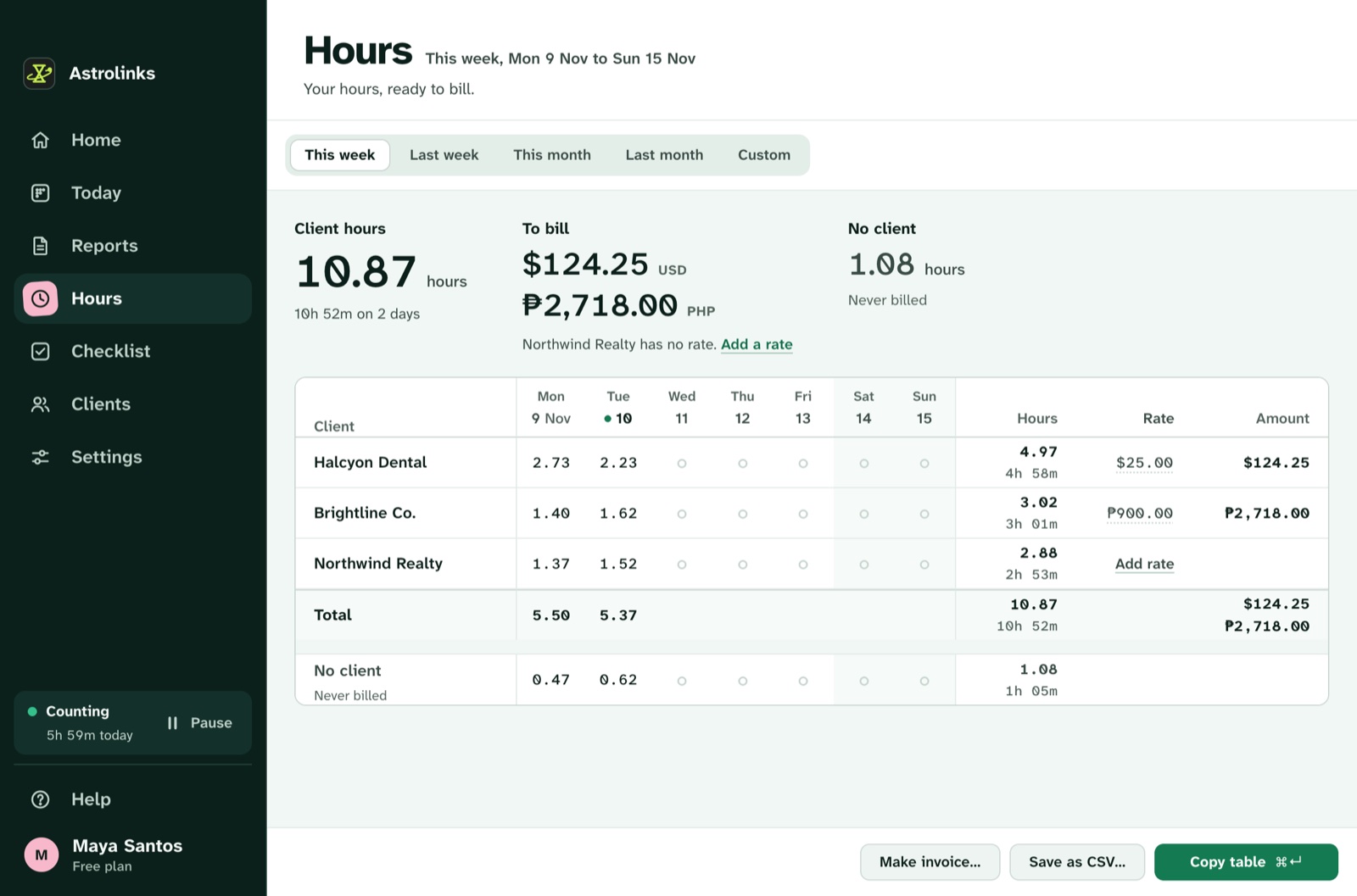
We make Astrolinks, a desktop app for Mac and Windows that helps with both. It keeps a private log of your workday on your own computer, with no screenshots and no keystrokes, and counts your hours per client at the rate you set for each. At clock-out it writes each client's end-of-day report, and you can make an invoice from your hours on any plan, including the free one. Every install starts with 7 days of Pro with no card. See hours and invoices.
What mistakes do VAs make when setting rates?
- Copying a number from a blog post. Including this one. Use the data as a check, not as your rate.
- Forgetting unpaid time. If you bill 40 hours, you're working closer to 50.
- Racing to the bottom on job platforms. Low bids attract clients who choose on price and leave on price.
- Never raising rates. A rate that was fair two years ago is probably low now.
- Not tracking hours, even on fixed prices. Without them you can't tell whether a package is profitable.
The short version
Start with your own numbers: target income, costs, a buffer for taxes and unpaid time, divided by the hours you can really bill. Check that floor against current data for your market. As of November 2026, that's about ₱27,500 a month on average in Philippine job postings and $23.23 an hour on average in US job postings on Indeed. Choose hourly, retainer or packages to suit each client, quote one clear number in the client's currency, and raise it when you're booked out.
If you're just starting, read how to become a virtual assistant and how to get clients as a virtual assistant next.