 Astrolinks


Short answer
A virtual assistant onboarding checklist covers four stages: before day one (contract, accounts and secure password sharing), the first day (a welcome call and two or three small tasks), the first week (written processes and a daily end-of-day report) and the first month (more ownership and a 30-day review). Copy the checklist below.
Astrolinks gives each person a daily report written from their own private log. No screenshots. Get it free →
Most VA relationships that fail don't fail because the assistant was bad. They fail in the first two weeks, when the business owner hands over a dozen logins, says "just help me with the inbox," and then feels frustrated that the VA isn't reading their mind. Good onboarding prevents that. It takes a few hours spread over a month and saves many more.
This checklist is for business owners and agencies bringing on a virtual assistant, whether it's your first hire or your fifteenth. It covers what to do before day one, on the first day, in the first week and through the first month, with a template for the daily report you should ask for from the start.
What should you prepare before a virtual assistant starts?
Do these before the first call. A VA who spends day one waiting for logins starts with the wrong impression of how the work will go.
- Contract signed. Scope, hours, rate, payment schedule and currency, confidentiality, and notice period.
- Working hours agreed. Which hours overlap with yours, and which time zone the VA reports in.
- Communication channel chosen. One place for messages, for example Slack or email, and what counts as urgent.
- Password manager set up. Create a shared vault or folder in a tool like 1Password or Bitwarden. Never send passwords in chat.
- Delegated access where possible. Gmail lets you grant another account access to your mailbox, and Google Calendar lets you share with "make changes" permission. Delegation is safer than sharing your own login.
- Two-step verification plan. Decide how the VA will get codes for shared accounts. Sending codes back and forth by text every morning doesn't scale.
- Starter document written. One page: who you are, what the business does, your top three priorities, your pet hates, and who's who.
- First-week task list ready. Five to ten small, real tasks with a clear finish.
Give only the access each task needs. You can always add more; taking it away later feels like a demotion.
What goes in the one-page starter document?
Use these headings and keep each to a few lines:
| Heading | Example |
|---|---|
| About the business | "We run a two-location physiotherapy clinic. Most patients book online." |
| Your top three priorities this month | "Clear the booking backlog, chase unpaid invoices, tidy the shared drive." |
| How I like to communicate | "One message with several questions beats five messages. Voice notes are fine." |
| What counts as urgent | "A patient complaint, a payment problem, anything from our landlord." |
| Things I care about | "Patients get a reply the same day. Never promise a refund without asking me." |
| Who's who | Names and roles of the people the VA will deal with |
| Tools and where things live | Inbox, calendar, shared drive, password vault |
A VA who has read this page asks better questions on day one, and you'll repeat yourself far less in week one.
What should happen on a virtual assistant's first day?
Keep day one small and successful.
- Welcome call, 30 to 45 minutes. Walk through the starter document. Ask the VA how they like to receive instructions.
- Check every login together. Fix what doesn't work while you're both on the call.
- Two or three small tasks. Things that can be finished today: tidy this week's calendar, answer a batch of routine emails from a template, set up a filing structure.
- Explain how you'll check in. A daily written update, and a short call once a week.
- First end-of-day report. Ask for one before they log off, even if the day was mostly setup.
A finished first task matters more than an impressive one. It shows both of you that the setup works.
How do you hand over processes in the first week?
The first week is about turning what's in your head into something written down.
- Record yourself doing each recurring task once. A screen recording with your voice is fine. Talk through why, not just what.
- Ask the VA to write the process document from your recording. This checks their understanding and gives you a standard operating procedure without writing it yourself.
- Review each process document. Correct it once, then let the VA own it.
- Add one recurring task per day. By Friday they should have three to five things they do on a schedule.
- Daily end-of-day reports. Read every one in week one and reply to at least one line each day.
- Friday call, 20 minutes. What's clear, what's confusing, and what they need from you.

The daily report to ask for from day one
Ask for the same short report at the end of every shift. It replaces the urge to check in all day and gives you a written record of what's being done.
EOD report: [Date]
Done today
- [Task]: [result, for example "sent", "booked", "filed"]
In progress
- [Task]: [where it stands, what's next]
Needs your decision
- [Question, with options if possible]
Tomorrow
- [First two or three tasks]
Hours today: [number]
The "needs your decision" section is the most valuable part for you. It collects every question in one place, so you can answer them in five minutes instead of being interrupted all day. For a fuller version, see our EOD report template for virtual assistants.
What should weeks two to four look like?
Week 2: recurring work
- VA runs every recurring task from the process documents without help.
- You stop reviewing routine output line by line and spot-check instead.
- Agree response times: how fast routine emails, urgent messages and requests from you get answered.
Week 3: ownership
- Hand over one whole area, for example inbox management or scheduling, not just tasks within it.
- Let the VA suggest one improvement to a process.
- Reduce your daily replies to the report. Answer questions and say thanks; you don't need to comment on everything.
Week 4: review
- Hold a 30-day review (see below).
- Update the starter document with anything you wish you'd said on day one.
- Agree the goals for the next 60 days.
How do you run a 30-day review?
Keep it to 30 minutes and cover five questions. Ask the VA to answer them in writing first.
| Question | What you're looking for |
|---|---|
| Which tasks do you own fully now? | A clear list, matching what you planned in week one |
| Which processes are still unclear? | Gaps in your documentation, not failures |
| What slowed you down most? | Access problems, slow answers from you, unclear priorities |
| What would you change? | At least one useful suggestion |
| What do you want to take on next? | Interest and ambition you can use |
Then give your own view on the same five points. Be specific about what's working. If something isn't, say what good looks like rather than what was wrong.
What if the VA works in a different time zone?
Many VAs in the Philippines work overnight for clients in the US, UK or Australia. That changes onboarding in a few small ways:
- Schedule the welcome call in the overlap, even if it means an early start for one of you. Do it once properly rather than three times by message.
- Front-load written instructions. A question asked at 2 a.m. your time won't get an answer until morning, so the starter document and process write-ups matter even more.
- Agree what the VA does when blocked. For example: note it in the report and move to the next task, rather than waiting.
- Ask for the report in your time zone. Times and "tomorrow" should mean your day, not theirs, so nothing gets misread.
What are the most common VA onboarding mistakes?
- Handing over everything at once. Twenty logins and "help me with everything" leaves the VA guessing.
- Sharing passwords in chat. They stay in message history forever. Use a password manager.
- No written processes. If it's only in your head, every task takes a call.
- Checking in all day. It feels like help, but it breaks focus. Ask for a daily report and read it.
- Installing screenshot monitoring on day one. It tells a new assistant you expect the worst. If you need proof of work, ask for clear reports and judge the results.
- Skipping the 30-day review. Small frustrations build up until someone quits.
Where Astrolinks fits
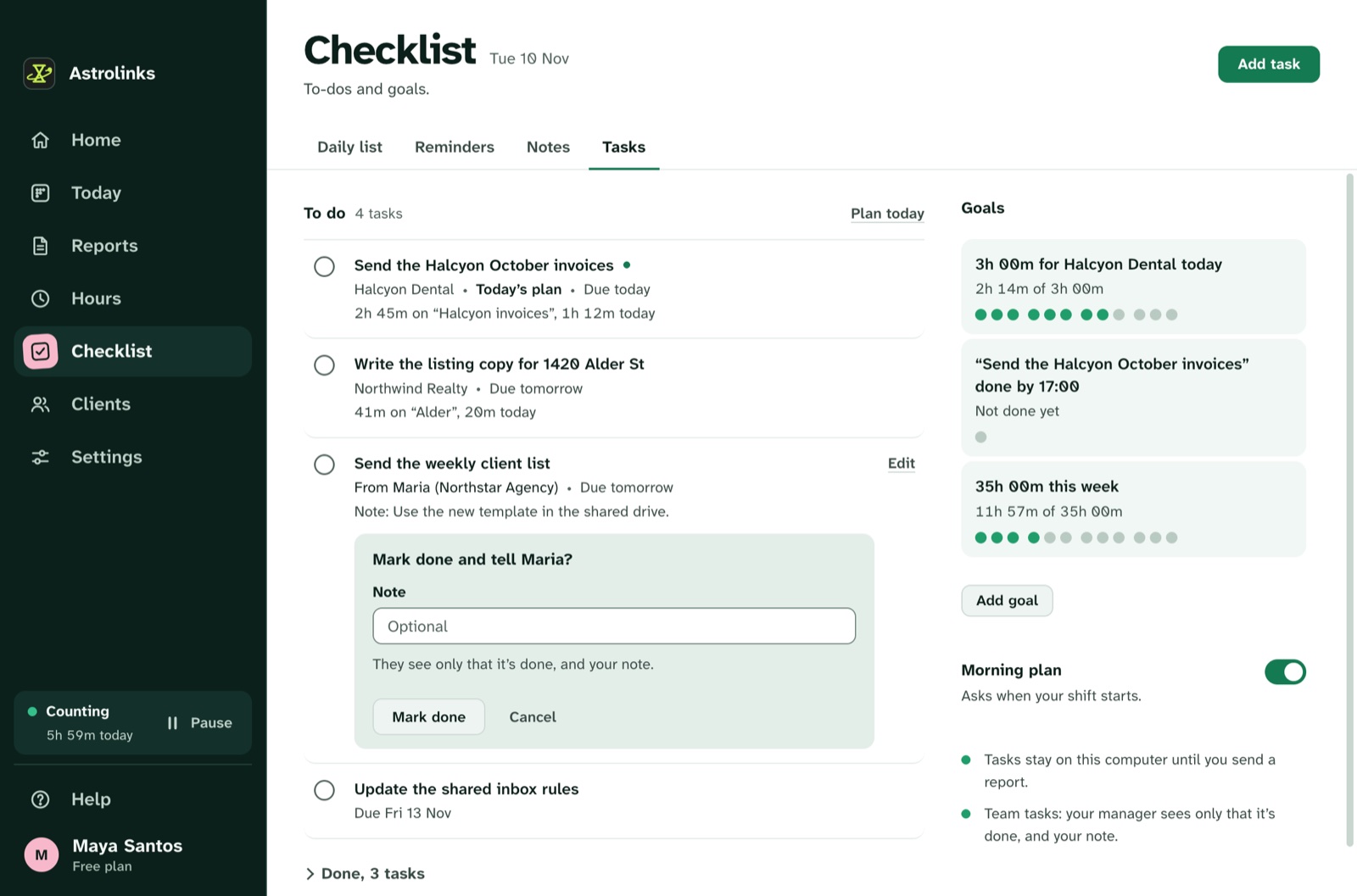
We make Astrolinks, a desktop app for Mac and Windows that writes the daily report this checklist asks for. It keeps a private log of the VA's workday on their own computer, sorted by client, with no screenshots and no keystrokes, and writes each client's end-of-day report at clock-out. The VA reviews it, can mark each item Finished, Sent, Drafted, Replied or In progress, and sends it.
For agencies, the Team plan adds an inbox of the reports people choose to send, never their activity, and managers can send tasks that land on the VA's list. See Astrolinks for agencies or for VAs in the Philippines.
The short version
Before day one: contract, access through a password manager or delegation, and a one-page starter document. Day one: a welcome call and small finishable tasks. Week one: record your processes and let the VA write them up. Every day: a short written report with a "needs your decision" section. Day 30: a review in writing on both sides. Onboarding is a month of small steps, and it's the cheapest month of the whole working relationship.