 Astrolinks


Short answer
To hire a Filipino virtual assistant, define the tasks and hours, post a clear job on OnlineJobs.ph or Upwork, shortlist people who follow your instructions, and give the best three a short paid test. Interview on video, agree on pay, holidays and 13th month pay in writing, pay on time through Wise, and ask for a daily update.
Astrolinks gives each person a daily report written from their own private log. No screenshots. Get it free →
The Philippines is one of the most popular places in the world to hire a virtual assistant, and for good reason. English is widely spoken and used in business, many people have years of experience working with US, Australian and UK clients, and the cost is a fraction of a local hire.
But hiring well takes more than posting a job and picking the first reply. This guide walks through how to hire a Filipino virtual assistant step by step: what to hire for, where to look, what to pay in 2026, how to test and interview, how to pay someone abroad, and how to set them up so you know the work is getting done.
It's written for agency owners and small business owners hiring their first or fifth VA. We're based in Cebu ourselves, so some of this comes from the other side of the table.
Why hire a Filipino virtual assistant?
- Strong English. English is an official language and widely used in schools, business and media.
- Experience with foreign clients. The Philippines has a large outsourcing industry and many experienced remote workers.
- Cost. Full-time VA pay is often a few hundred to around a thousand US dollars a month, depending on skills. Fair pay locally, affordable for most small businesses.
- Time zones that can work for you. For US clients, a night shift in Manila covers your day. For Australian clients, the hours largely overlap.
What it isn't: a way to get skilled work for almost nothing. The best VAs have plenty of options, and they choose clients who pay fairly, pay on time and treat them well.
Step 1: Decide exactly what you're hiring for
The most common hiring mistake is a vague role. "General VA to help with everything" attracts everyone and fits no one.
Write down:
- The tasks, as specifically as you can: "schedule Instagram and Facebook posts for 4 clients", "answer support emails in Help Scout", "reconcile Xero every week".
- The tools they'll use: Canva, Asana, HubSpot, Shopify, whatever applies.
- The hours: full-time or part-time, and whether they need to work during your business hours or can work their own.
- What success looks like after 30 and 90 days.
If the list includes very different skills, like bookkeeping and video editing, you probably need two people, or one person and a freelancer.
Our virtual assistant job description template gives you a ready-made structure.
Step 2: Where do you find Filipino virtual assistants?
OnlineJobs.ph is the biggest job board focused on Filipino remote workers. You post a job, browse profiles and hire directly, with no fee taken from the worker's pay. As of November 2026, its pricing page listed a free plan with limits, and paid plans from $69 a month that let you contact applicants; its FAQ says free accounts can't see contact details or message workers. Check their pricing page for current details. Many owners pay for one month, hire, then cancel.
Upwork has many Filipino freelancers and handles contracts and payment, which some owners like for the first hire. It charges fees, so it's often better for project work than long-term full-time roles.
Staffing agencies recruit, screen and sometimes manage the VA for you, and can replace someone who leaves. You pay more, often a markup on the VA's pay. Worth it if you have no time to hire.
Referrals from other business owners, and from VAs you already work with, are often the best source of all. Good VAs know other good VAs.
Facebook groups for Filipino VAs have many candidates too, but take more filtering.
Step 3: Write a job post that filters for you
A good job post does half your screening. Include:
- What your business does and who the clients are
- The specific tasks and tools
- Hours and time zone expectations, said plainly ("Monday to Friday, 9 PM to 5 AM Manila time")
- The pay, or at least a range
- One small instruction to follow, such as "start your application with the word 'blue'" or "answer these three questions"
That last one matters. Attention to detail is a core VA skill, and anyone who ignores a simple instruction in the application will likely ignore instructions in the job.
Step 4: How much should you pay a Filipino virtual assistant?
Pay depends on skills, experience, hours and whether the role needs night shifts. As a reference point, as of November 2026:
- Indeed Philippines showed an average of about ₱27,500 a month for virtual assistant roles in job postings.
- One staffing firm's data showed a median ask of about US$714 a month (around ₱40,000) for full-time remote VA roles, with the middle half between US$571 and US$900.
Specialist roles such as bookkeeping, paid ads, SEO, development or project management usually cost more. Our post on how much virtual assistants charge has the sources and more detail.
A few things to agree on up front:
- Night shift pay. If you need US hours, it's fair to pay more.
- 13th month pay. Philippine law requires it for employees of Philippine employers. Most foreign clients hire VAs as contractors, where it isn't legally required, but many Filipino workers expect it and many clients pay it in December. Decide and put it in writing.
- Holidays and time off. The Philippines has many public holidays, and Christmas is a big deal. Agree which days off are paid.
- Raises. Say when you'll review pay. Good VAs who never get a raise eventually leave.
This isn't legal or tax advice. If you're unsure about contractor versus employee status, check with an accountant or lawyer.

Step 5: Shortlist, test and interview
Shortlist candidates who followed your instruction, have relevant experience and write clearly.
Give the top three a paid test task. One to two hours of real-ish work: draft three social posts from a brief, clean up a messy spreadsheet, reply to three sample support emails. Pay for it. It shows respect and you'll get better effort.
Interview on video, with the same questions for everyone so you can compare fairly. For example:
- "Walk me through a task you did for a past client, from brief to finished."
- "Tell me about a time something went wrong while the client was asleep. What did you do?"
- "What do you need from a client to do your best work?"
- "What happens if your power or internet goes out during a shift?"
That last question matters. Brownouts happen, and good VAs have a backup plan, such as a mobile data connection or a coworking space nearby.
Check references from past clients if you can.
Choose the person whose test work was best and who asked good questions. Asking questions is a good sign, not a weakness.
Step 6: Agree on terms in writing
Before work starts, write down and both sign:
- Role, tasks and hours
- Pay, currency, pay schedule, method and who pays transfer fees
- 13th month pay, holidays and paid time off
- Confidentiality and who owns the work
- How either side ends the arrangement, and notice period
Our virtual assistant contract template covers the usual clauses.
Step 7: Pay on time, every time, in a way that works for them
Late or short pay is the fastest way to lose a good VA. Pick a method together:
- Wise: low, clear fees and good exchange rates. Many Filipino VAs prefer it.
- PayPal and Payoneer: common, but fees and exchange rates can take a noticeable cut.
- Deel or similar: handles contracts and payment for a higher fee.
Many VAs then move money into their bank or GCash. Pay on the same dates every month, and tell them early if anything changes.
Step 8: Onboard properly
The first two weeks decide whether a hire works out. Have logins ready before day one, send a written welcome with their clients, tasks, hours and who to ask, start with small clear tasks with examples, and give quick feedback.
Our virtual assistant onboarding checklist has a full list, and our guide on how to manage an offshore team covers overlap hours, weekly rhythm and trust.
Step 9: How do you know the work is getting done?
Once your VA starts, you'll want to know what they're doing, especially if they work while you sleep. Many owners reach for screenshot software. It usually backfires: it measures activity, not results, and good VAs often see it as a sign you don't trust them.
A better way:
- Agree on two or three outcomes for the role
- Ask for a short written update at the end of every shift: done, next, blocked
- Spot-check the real work once or twice a week
- Answer blockers before their next shift
- Hold a 15-minute weekly call
Our guide on how to know if remote employees are working explains this system in full, and how to manage a virtual assistant gives you a weekly rhythm for the months after.
Where Astrolinks fits
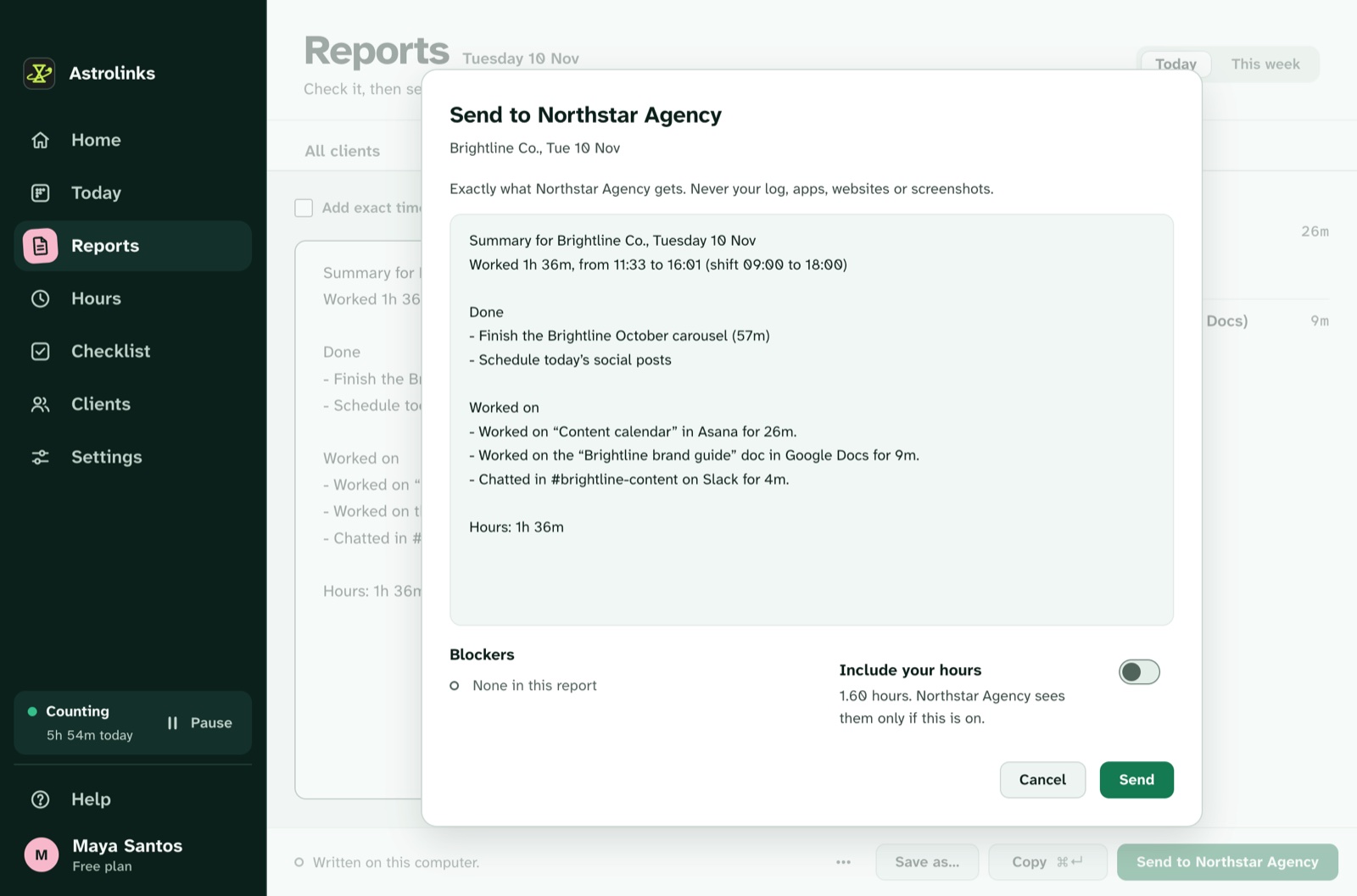
We make Astrolinks, so read this with that in mind. Astrolinks is a desktop app for Mac and Windows that makes the end-of-shift update easy. It keeps a private log of your VA's workday on their own computer, sorted by client, and drafts their report at clock-out. They check it and send it. On the Team plan, reports from all your VAs land in one inbox, split by client, ready to forward. No screenshots and no keystroke logging.
If you run an agency with remote staff, we're running free 14-day pilots for up to 5 people, no card needed. Ask for a pilot or read about Astrolinks for agencies.
The short version
To hire a Filipino virtual assistant: define the role precisely, post on OnlineJobs.ph, Upwork or through referrals, filter with a simple instruction in the job post, give the top three a paid test, and interview on video. Pay fairly, agree on 13th month pay, holidays and transfer fees in writing, and pay on time through something like Wise. Then onboard properly and use a short daily update, not screenshots, to know the work is getting done.