 Astrolinks


Short answer
To hire remote employees, define the role by outcomes, decide on time zone and hours, post where remote candidates look, screen for clear writing and self-management, give a short paid test task, interview on video, choose how to hire legally (contractor, local entity or employer of record), put terms in writing, and onboard with written instructions and a daily update habit.
Astrolinks gives each person a daily report written from their own private log. No screenshots. Get it free →
Hiring remotely opens up a much bigger pool of talent than your city can offer. It also brings new questions: where to look, how to tell if someone will work well without supervision, how to hire someone in another country legally, and how to make sure they're productive from week one.
This guide walks through how to hire remote employees in nine steps, from writing the role to the first week of onboarding. It's written for agency owners and small business owners, whether you're hiring your first remote person or your tenth.
Step 1: Define the role by outcomes, not hours
Start with what the person will achieve, not just what they'll do. A role description that lists outcomes attracts better candidates and gives you something to measure later.
Write down:
- The main outcomes for the first 90 days, such as "take over all client social media scheduling" or "cut support reply time to under 4 hours".
- The day-to-day tasks and the tools involved.
- Must-have skills versus nice-to-haves.
- Who they'll work with and who they report to.
If you'll judge them by outcomes, say so in the job post. Strong remote candidates like that.
Step 2: Decide on time zones, hours and pay
Remote doesn't mean "anywhere, anytime" for every role. Decide:
- Time zone overlap. Does the role need to be online during your clients' hours, or just overlap two or three hours with you? Client-facing roles usually need more overlap.
- Full-time, part-time or project-based.
- Pay range. Decide whether you'll pay the same for the role everywhere or adjust for location. Both are common; be consistent and open about it.
Being clear here filters out candidates who can't work the hours you need, before you've spent time interviewing them.
Step 3: Write a job post that attracts remote talent
A good remote job post includes:
- What your company does and who the clients are
- The outcomes and tasks from step 1
- Hours, time zone and overlap needed
- Pay range
- How you work: async or meeting-heavy, tools you use, how updates work
- The hiring process and timeline
- A simple instruction to follow in the application, like answering two short questions
The instruction is a quick filter. Remote work depends on reading carefully and following written instructions. Our virtual assistant job description template works for many remote roles beyond VAs.
Step 4: Post where remote candidates look
- Remote job boards like We Work Remotely and Remote OK reach people specifically looking for remote work.
- General job boards such as LinkedIn and Indeed, with the job marked as remote.
- Country-focused boards. For the Philippines, OnlineJobs.ph is the largest; see our guide on how to hire a Filipino virtual assistant.
- Freelance marketplaces like Upwork, especially for contract or part-time roles.
- Referrals from your team, clients and network. Often the best hires of all.
Step 5: What skills should you screen remote candidates for?
Beyond the core skills of the role, remote employees need a few extra abilities. Look for:
- Clear writing. Most remote collaboration happens in writing. Their application is your first sample.
- Self-management. Have they worked remotely before? How do they plan their day?
- Reliability. Do past clients or employers mention meeting deadlines?
- Asking questions. People who ask good questions early make fewer costly guesses later.
- A workable setup. Reliable internet, a quiet space, and for some regions, a backup for power cuts.
Shortlist five to ten candidates who followed your instructions and meet the must-haves.
Step 6: Give a short paid test task
A paid test is the most reliable way to see how someone actually works. Keep it to one to three hours of realistic work:
- A writer drafts a short post from a brief
- A designer creates one social graphic from your brand guide
- A support hire answers three sample customer emails
- An ops assistant cleans up a messy spreadsheet and writes a short summary
Pay for it at a fair rate. You'll get better effort, and good candidates won't drop out of your process. Judge the work, but also the communication: did they ask clarifying questions, meet the deadline and explain their choices?

Step 7: Interview on video
Invite your top two or three to a video interview of 30 to 45 minutes. Good questions for remote roles:
- "Walk me through how you plan a typical workday."
- "Tell me about a time you were stuck and your manager wasn't available. What did you do?"
- "How do you like to receive feedback?"
- "What do you need from a manager to do your best work?"
- "What questions do you have about the test task?"
Check references from past employers or clients if you can. Ask specifically about reliability and communication.
Score every finalist the same way, straight after each interview and before you compare notes with anyone:
| Area | What a top score looks like |
|---|---|
| Test task | Ready to send to a client with light edits |
| Writing | Clear and short, no follow-up needed to understand it |
| Questions | Spotted gaps in the brief before starting |
| Reliability | Met the test deadline, and references confirm it |
| Hours | Can cover the overlap you need without strain |
Scoring each area separately stops the most confident talker from winning by default.
Step 8: How do you hire a remote employee in another country?
When the person lives in another country, how you hire them matters. The common options:
| Option | How it works | Good for |
|---|---|---|
| Independent contractor | They invoice you; they handle their own taxes | Project work, flexible roles, many offshore VAs |
| Employer of record (EOR) | A company such as Deel or Remote employs them locally on your behalf, for a monthly fee | Long-term, full-time roles abroad where you want full compliance |
| Your own local entity | You set up a company in their country | Larger teams in one country |
Contractor relationships are the simplest, but in many countries, someone who works full-time for one client, on that client's schedule, under close direction, may legally count as an employee. Misclassification can bring back taxes and penalties. This isn't legal advice; check with a lawyer or accountant, especially for full-time roles.
Whatever you choose, put the terms in writing: role, hours, pay, payment method and schedule, time off, confidentiality, ownership of work, and how either side can end it. Our virtual assistant contract template covers the usual clauses for contractor arrangements.
Step 9: Onboard properly in the first two weeks
A remote hire's first two weeks decide a lot. Before day one, set up every login and send a written welcome with their role, clients, hours, tools and who to ask. On day one, do a video call to walk through everything. In week one, give small, clear tasks with examples of good work. By week two, they should be on real work with fast feedback.
Our guide to how to onboard remote employees has a day-by-day first week and a 30-day plan, and the virtual assistant onboarding checklist covers VA-specific access and SOPs.
Start the daily update habit on day one too: at the end of each shift, a short note with what's done, what's next and what's blocked. It helps the new person feel connected, lets you answer their questions fast, and shows you how they're doing without micromanaging. See how to know if remote employees are working.
How do you know a new remote hire is working out?
Decide what good looks like at 30, 60 and 90 days before they start, and check against it:
- Day 30: handles routine tasks without step-by-step help, sends a daily update every shift, and asks questions in writing instead of waiting.
- Day 60: owns at least one outcome from step 1 end to end, and you rarely correct the same thing twice.
- Day 90: meets the outcomes you set and suggests improvements without being asked.
Book a short review call at each point. Our one-on-one meeting template gives you a simple agenda. If something is off at day 30, say so plainly and agree on one or two specific changes. Often the cause is unclear instructions, not a bad hire. If nothing improves by day 60 despite clear feedback, ending it early, as the contract allows, is usually kinder to both sides.
What mistakes should you avoid when hiring remote employees?
- Hiring for skills alone. A brilliant specialist who can't communicate in writing will struggle remotely.
- Skipping the test task. Interviews show how people talk. Tests show how they work.
- Vague roles. "Help with marketing" attracts everyone and suits no one.
- Ignoring time zones until after the hire.
- Unclear pay terms. Currency, payment method, fees and pay dates should all be agreed upfront.
- No onboarding plan. Leaving a new remote hire to "figure it out" is the fastest way to lose them.
Where Astrolinks fits
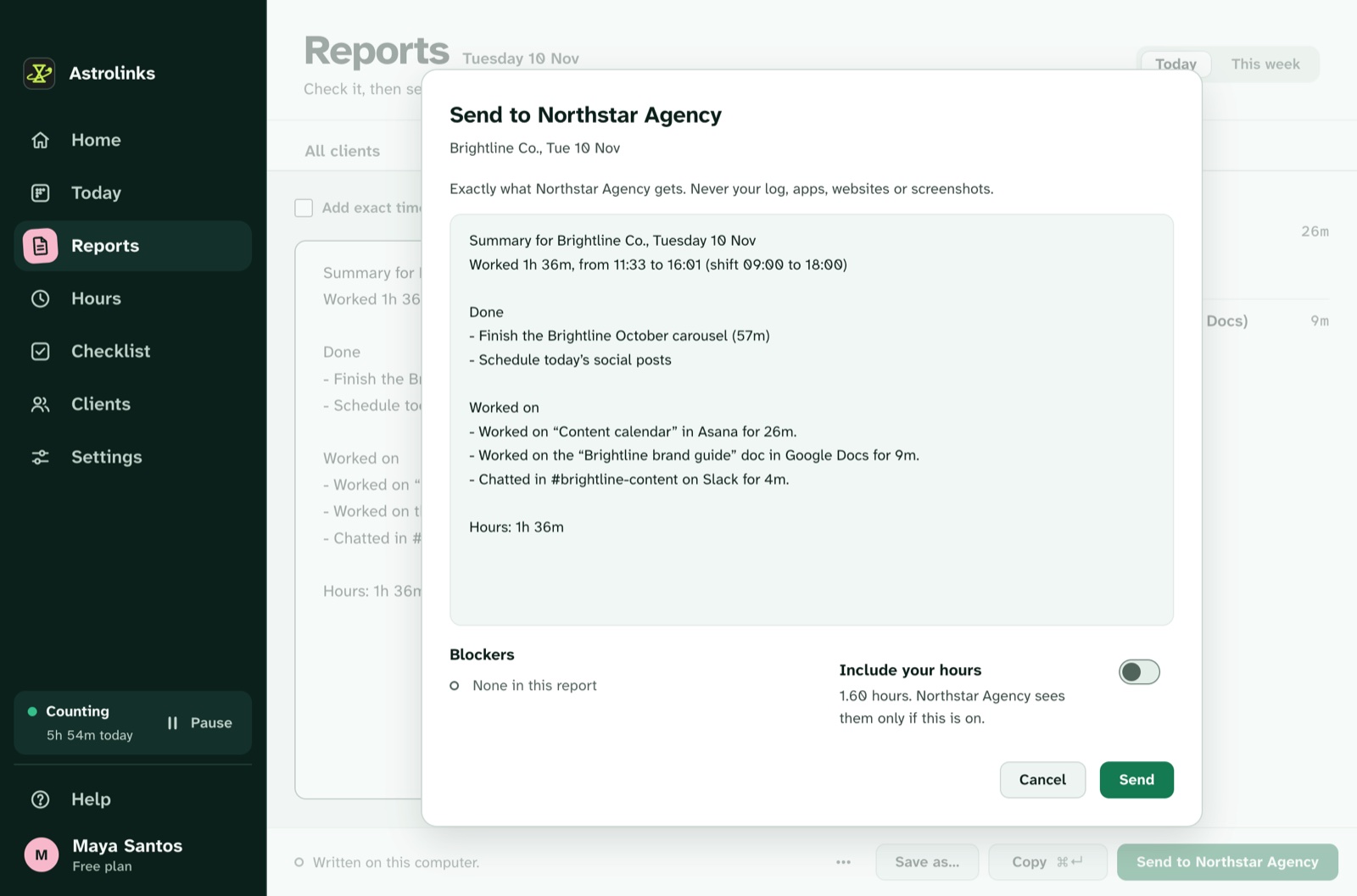
We make Astrolinks, so read this with that in mind. Once you've hired, Astrolinks helps you see how new remote employees are getting on without watching their screens. It's a desktop app for Mac and Windows that keeps a private log of each person's workday on their own computer, sorted by client, and drafts their end-of-day report at clock-out. They check it and send it. On the Team plan, reports land in one inbox for you, split by client. No screenshots and no keystroke logging.
If you run an agency with remote staff, we're running free 14-day pilots for up to 5 people, no card needed. Ask for a pilot or read about Astrolinks for agencies.
The short version
To hire remote employees: define the role by outcomes, decide on hours and pay, write a clear job post with a simple instruction, post on remote and country-focused job boards, screen for clear writing and self-management, give a short paid test, and interview on video. For hires abroad, choose between contractor, employer of record or your own entity, and get advice if unsure. Then onboard properly and start a daily written update from day one.