 Astrolinks


Short answer
To motivate a remote team, give each person clear goals and ownership, remove blockers quickly, recognize good work specifically and often, pay fairly and on time, trust people instead of watching their screens, and make room for growth and human connection. Most remote teams lose motivation from unclear work, slow answers and feeling unseen, not missing perks.
Astrolinks gives each person a daily report written from their own private log. No screenshots. Get it free →
Motivating a team is harder when you can't see anyone. You don't notice someone's had a rough week, you can't stop by a desk to say "nice work", and small frustrations stay quiet until they turn into a resignation.
The good news: what motivates remote employees isn't mysterious, and it isn't expensive. It's mostly clear work, quick help, honest recognition and fair treatment. This guide covers 10 things that actually work for remote and offshore teams, and the common habits that quietly drain motivation.
It's written for agency owners and small business owners with remote staff, but it applies to any remote team.
Why do remote teams lose motivation?
Before adding anything, it helps to know what usually goes wrong. Remote teams rarely lose motivation because there's no office snack bar. They lose it because:
- The work is unclear. People don't know what "good" looks like or what matters most this week.
- They wait too long for answers. A blocker that sits for a day turns into frustration and lost pay for hourly workers.
- They feel unseen. Good work disappears into a task manager with no reply. Mistakes get noticed instantly.
- They feel watched instead of trusted. Screenshot software and constant check-ins tell people you expect them to slack off.
- Pay is late or unfair. For offshore staff, a delayed payment can mean a missed rent payment.
Most of the fixes below target one of these.
1. Give clear goals and real ownership
People are more motivated when they know exactly what they're responsible for and have room to decide how to do it. For each person, write down two or three outcomes that define a good week, like "all client posts scheduled 7 days ahead" or "support tickets answered within 4 hours".
Then let them own it. Ask "how do you want to approach this?" more often than you give step-by-step orders. Our guide to measuring remote employee productivity shows how to choose outcomes per role.
2. Remove blockers fast
Nothing kills momentum like being stuck and unable to get an answer. On a remote team, especially across time zones, a question at the start of someone's shift can sit for 12 hours.
Make it a rule: blockers get answered before the person's next shift starts. Give people a backup contact, and a list of what to work on while they wait. A short daily update with a "blocked" section makes problems visible the same day.
3. Recognize good work, specifically and often
"Good job" is nice. "The way you rewrote that client's onboarding email cut their reply time in half" is motivating. Specific recognition shows you actually looked at the work.
- Reply to good work the same day
- Share wins in the team channel, not only in private
- Forward client praise to the person who did the work, with their name on it
A good recognition message names the work, the result and the person, in that order:
Shoutout to Ana: she rebuilt the Brightline onboarding email on Monday.
Their new sign-ups now reply in hours instead of days, and the client
noticed. Thanks Ana, this one made us look good.
Recognition costs nothing and is one of the most powerful motivators there is, especially for remote staff who otherwise rarely hear how their work landed.
4. Pay fairly and on time, every time
This sounds obvious, but it's where many remote teams, particularly offshore ones, lose good people. Pay on the same dates every month. Use a method that's cheap and fast for them to receive. Review pay at least once a year, and say when that review will happen.
For Filipino VAs and other offshore staff, small things like a 13th month bonus in December, paid holidays and covering transfer fees show you value them. Our guide on how much a virtual assistant costs covers what's normal.
5. Trust people instead of watching them
Screenshot tools and activity scores feel like control, but they often backfire. Your best people take them as a sign of distrust, and everyone learns to perform activity instead of doing good work.
Trust by default, and check outcomes instead of screens. If the work gets done, well and on time, the person is working. Our guide on how to know if remote employees are working explains a simple system that replaces surveillance.

6. Connect their work to real results
People want to know their work matters. Tell your VA that the leads they qualified turned into a new client. Show your designer the campaign results. Share what a client said about the report your team prepared.
Remote workers often see only their slice of a project. Showing them the whole picture, and their part in it, is a quick way to raise motivation.
7. Hold short, regular one-on-ones
A weekly 15-minute one-on-one is where you catch problems early, hear ideas, and show you care about the person, not just the output. Ask:
- What's going well?
- What's slowing you down?
- Is there anything you'd like to learn or do more of?
Keep it consistent. Cancelling one-on-ones whenever you're busy tells people they're a low priority.
8. Offer a path to grow
Motivated people want to get better and earn more. Talk about growth at least every few months:
- New skills they could learn, perhaps with a course you pay for
- Bigger responsibilities, like owning a client or training a new hire
- A clear link between new skills and pay
Many VAs and remote specialists leave not because they're unhappy, but because they can't see a next step. Give them one.
9. Respect time zones and working hours
If your team call always lands at midnight for the same people, motivation will drop. Rotate meeting times, record calls, and keep most communication async. Don't expect instant replies outside agreed hours.
If you need people to work night shifts to cover your clients' hours, say so upfront and pay for it fairly. Our post on time zone etiquette has more practical tips.
10. Make room for human connection
Remote work can be lonely. A little social time goes a long way:
- A team channel for non-work chat, photos and wins
- An optional, short monthly video call with no agenda
- Remembering birthdays and work anniversaries
- Asking how people are, and meaning it
Keep it optional and short. Forced fun on someone's evening isn't a reward.
What kills motivation on a remote team?
Avoid these habits, even with good intentions:
- Constant check-ins. "Any update?" messages several times a day signal distrust. One written update per day is enough. Our guide to remote team updates without micromanaging shows how to set that up.
- Moving goalposts. Changing priorities without explaining why makes people feel their work is wasted.
- Only giving negative feedback. If you only speak up when something's wrong, people start dreading your messages.
- Unpaid extra work. Asking for "just a few extra hours" again and again, without pay, wears people down fast.
- Ignoring updates. If someone writes a daily report and nobody ever reads or replies, they'll stop writing it well.
How can you tell a remote team member is losing motivation?
In an office you'd notice someone go quiet. Remotely, the signs show up in writing first. Watch for:
- Daily updates get shorter and vaguer. "Worked on client stuff" where there used to be a clear list.
- Questions stop. People who used to ask a lot and suddenly ask nothing are often guessing or have stopped caring.
- Small deadlines start to slip, one or two a week, without a heads-up.
- One-on-ones get moved or skipped, or turn into "all good, nothing to report".
- Replies slow down during hours they used to be quick.
One sign on its own means little; everyone has a slow week. Two or three together for a couple of weeks is worth a private conversation. Don't open with the problem. Open with a question:
Hey Marco, you've seemed a bit quieter the last couple of weeks.
No problem with the work, I just wanted to check in. How are things
going, and is anything about the job getting in your way?
Then listen. The cause is usually one of the things in the "why" list above: a blocker nobody cleared, unclear priorities, pay worries or a role that's stopped growing. Fix the cause, and say what you changed.
A simple weekly rhythm that keeps a remote team motivated
| When | What | Why it helps |
|---|---|---|
| Every day | Each person sends a short update: done, next, blocked | Blockers get seen; good work gets noticed |
| Every day | You reply to blockers before their next shift | Nobody stays stuck |
| Every week | 15-minute one-on-one with each person | Catch problems early, talk growth |
| Every week | Share wins and client praise in the team channel | Recognition in public |
| Every month | Optional social call; check pay dates went out on time | Connection and trust |
| Every year | Pay review | People see a future |
Where Astrolinks fits
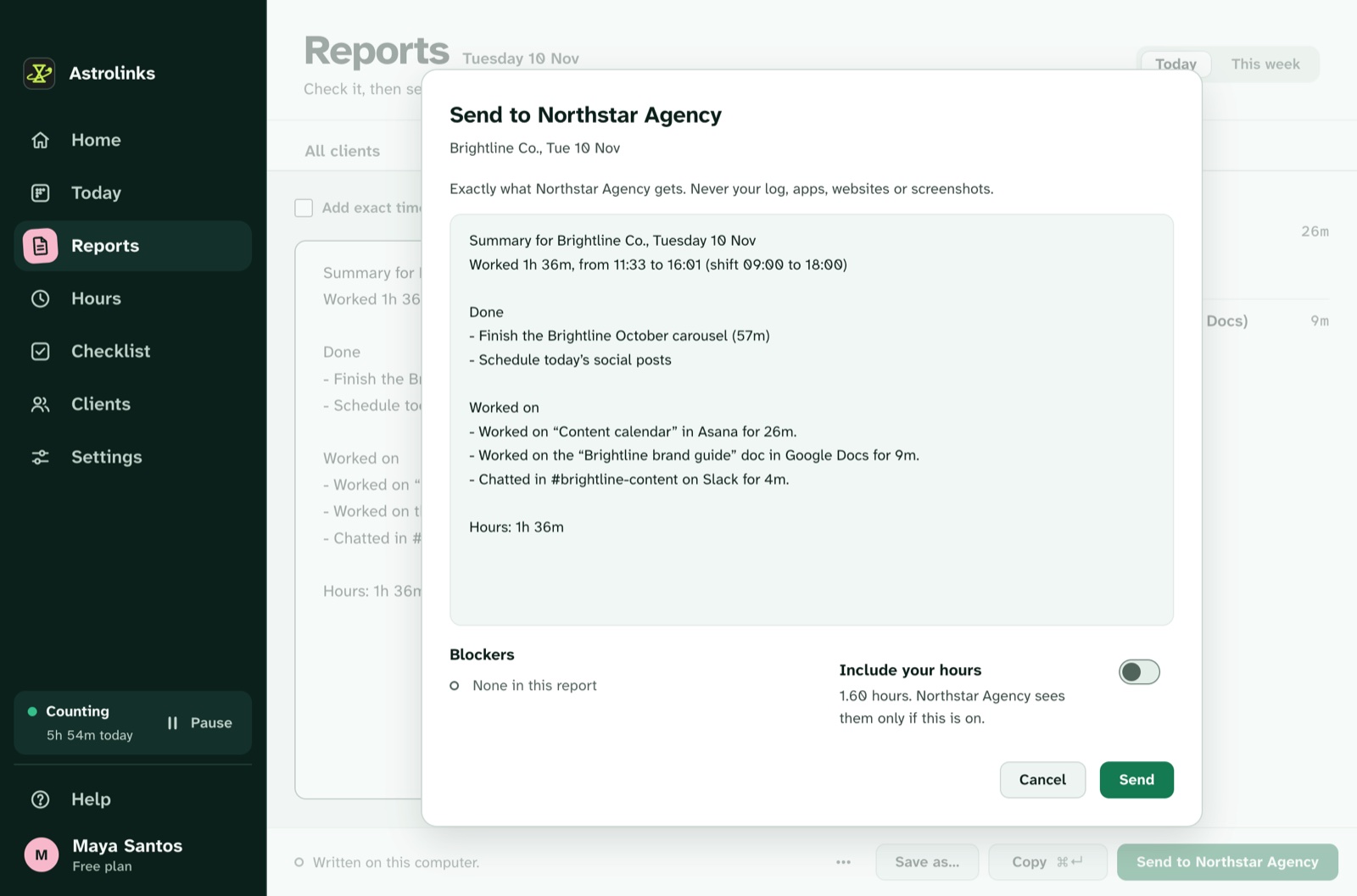
We make Astrolinks, so read this with that in mind. Astrolinks is a desktop app for Mac and Windows that makes the daily update painless. It keeps a private log of each person's workday on their own computer, sorted by client, and drafts their end-of-day report at clock-out. They check it and send it in a minute instead of writing it from scratch. On the Team plan, reports land in one inbox for you, split by client, so it's easy to spot wins worth recognizing and blockers to clear. No screenshots and no keystroke logging, so people feel trusted, not watched.
If you run an agency with remote staff, we're running free 14-day pilots for up to 5 people, no card needed. Ask for a pilot or read about Astrolinks for agencies.
The short version
To motivate a remote team, get the basics right first: clear goals and ownership, fast answers to blockers, specific recognition, fair and on-time pay, and trust instead of surveillance. Then add growth, respect for time zones and a little human connection. Most remote teams don't need more perks. They need to know what matters, get help when they're stuck, and feel that someone notices their good work.