 Astrolinks


Short answer
Daily standup vs EOD report comes down to timing and format: a standup is a short meeting at the start of the day where teammates coordinate, while an EOD report is a written note sent at the end of a shift. Standups suit teams that share hours and work. EOD reports suit clients, time zones and independent work.
Want your EOD report written for you? Astrolinks writes it from your actual workday when you clock out. Get it free →
Two habits keep coming up when teams talk about staying in sync: the daily standup and the end-of-day report. They look similar. Both are short, daily, and about progress. But they answer different questions at different times. This guide on daily standup vs EOD report explains what each one is good at, when to pick one, how to switch, and how to use both without doubling the work.
What is a daily standup?
A daily standup is a short meeting, usually at the start of the day. Each person answers three questions:
- What did I do yesterday?
- What will I do today?
- Is anything blocking me?
It comes from software teams, where it helps people coordinate on shared work. The point isn't reporting to a manager. It's teammates finding out who needs what from whom.
Standups can also be async: everyone posts their answers in a Slack channel instead of meeting. Our guide to async check-ins for remote teams covers that version in detail.
What is an EOD report?
An end-of-day report is a short written note sent at the end of a shift. It usually covers:
- what got done today
- what's blocked
- what's next
It's common with virtual assistants, freelancers, support teams and anyone who works for a client. The reader is often someone outside the work: a client, a manager, or an agency lead.
Daily standup vs EOD report, side by side
| Daily standup | EOD report | |
|---|---|---|
| When | Start of the day | End of the day |
| Format | Meeting, or async post | Written note |
| Looks | Mostly forward | Mostly back, plus next steps |
| Main reader | Teammates | Client or manager |
| Best for | Coordinating shared work | Showing progress and flagging blockers |
| Time zones | Hard across many | Works across any |
| Memory | Yesterday is a bit hazy | Today is fresh |
| Leaves a record | Only if written | Always |
| Cost | Everyone's time, at once | A few minutes each, whenever suits |
The last row matters more than it looks. A 15-minute standup for eight people costs two hours of team time every day, and it lands at the same moment for everyone. An EOD report costs each person about five minutes, at the end of their own day.
When a daily standup works best
Pick a standup when:
- several people work on the same project and depend on each other
- the team shares most of its working hours
- quick decisions often need two or three people at once
- the team is small enough that 15 minutes covers everyone
Software teams in one or two nearby time zones are the classic fit. The meeting helps people spot overlap and ask for help.
When an EOD report works best
Pick an EOD report when:
- the reader is a client, not a teammate
- people work different hours or in different time zones
- each person's work is mostly independent
- you need a written record for billing or handovers
- meetings would cut into focus time
VAs, freelancers, support desks and distributed agencies are the classic fit. A night shift VA in Manila and a client in Texas will never share a standup, but the client can read a report over breakfast.
Should your team use a daily standup or an EOD report?
Use a standup when work overlaps and hours are shared, and an EOD report when work is independent or spread across time zones. Find your team in this table. It's a starting point, not a rule.
| Your team | Best fit | Why |
|---|---|---|
| 5 developers, same time zone, one product | Standup | Work overlaps daily; a quick call saves many messages |
| VA agency, 12 VAs, 30 US clients | EOD reports | Each VA's work is separate, and clients read the reports |
| Support desk on shifts | EOD reports | The next shift needs a written handover, not a meeting |
| Design studio, 4 people, US and Europe | EOD reports plus a weekly call | Little shared time; decisions can wait a day |
| Startup team, mixed roles, all in one city | Both, kept short | Shared work, and a record for the founder |

Can you use a daily standup and an EOD report together?
Yes, many teams do both. Done carelessly, that means writing the same thing twice. Done well, each one feeds the other.
A simple way:
- End of day: each person writes their EOD report. Done, Blocked, Next.
- Start of the next day: the standup is short, because everyone has already read the reports. It's only for blockers and decisions.
Or, for fully async teams:
- End of day: EOD report, sent to the team channel or inbox.
- No standup. A weekly call covers anything bigger.
The rule that keeps this light: nobody repeats their report out loud. The standup opens with "Any blockers from yesterday's reports?" and goes straight to decisions.
Templates for both
Async standup post
Yesterday: finished the refund email fix; reviewed 2 PRs
Today: tests for the refund flow; pair with Sam on the export bug
Blocked: need access to the staging logs
EOD report
Done today
- Shipped the refund email fix
- Reviewed PRs for checkout and search
Blocked
- Staging logs access (asked in #infra at 2:10 PM)
Tomorrow
- Tests for the refund flow
Short standup agenda (when you keep both)
- Blockers from last night's reports (5 min)
- Decisions that need two or more people (5 min)
- Anything that changed overnight (2 min)
For more EOD formats, see our guide on how to write an end-of-day report, which has three templates.
Signs your standup should become an EOD report
Standups are easy to start and hard to stop. Watch for these signs that yours has outgrown its job:
- People join from very different hours. If someone is dialing in at 10:00 PM their time, the meeting is costing more than it gives.
- It's become a status report to the manager. If people speak to the lead instead of each other, a written report does the same job without the meeting.
- Updates repeat. "Still on the same ticket" three days running is a sign the format isn't helping.
- It regularly runs past 15 minutes. Discussion has crept in. Move it elsewhere.
- Nobody remembers what was said. Without a written record, the standup leaves nothing to look back on.
How to switch: a two-week trial
If two or more of those signs sound familiar, don't cancel the standup overnight. Run a trial.
- Day 1: tell the team why. "We're trying written reports for two weeks to give back our mornings."
- Agree the format: Done, Blocked, Tomorrow. One channel or inbox. Sent before you log off.
- Agree the reply rule: the lead answers every blocker by the start of the next working day.
- Keep one weekly call for planning and anything that needs talking through.
- Day 10: ask each person two questions. Did you get blocked longer than before? Did you get time back?
If blockers waited longer, add back a short twice-a-week call. If not, you've saved the team several hours a week. Our guide on remote team updates without micromanaging covers how leads can read reports without turning them into surveillance.
Signs you still need a standup
The reverse is true too. If people often wait a day for an answer a teammate could give in a minute, or work keeps getting done twice because nobody knew someone else had it, a short live check-in earns its place.
What the lead should do with EOD reports
Written reports only replace a meeting if someone reads them and acts. If you lead the team, this is your side of the deal:
- Read them at a set time. First thing in your morning works for most leads. Twenty reports of five lines each take about ten minutes.
- Answer every blocker. Even "I'll have it by noon" counts. A blocker that gets no reply teaches people to stop writing them.
- Reply to the person, not the channel, when it's about one person's work. Save the channel for things the whole team needs.
- Don't grade the reports. A short report on a quiet day is fine. If you start counting lines, people will pad them.
- Spot patterns weekly. The same blocker in three reports is a process problem, not a people problem. Fix it once.
A simple reply habit is enough for most teams:
Thanks, all read. Sam: staging logs access is granted now. Priya: let's talk about the export bug at 11:00 AM. Everyone else, nothing from me today.
One message, sent at the same time each morning, and the team knows the reports matter.
The case for writing at the end of the day
One reason EOD reports catch on with remote teams: they're written while the day is fresh. A standup asks you to remember yesterday first thing in the morning, before coffee, when the details have faded. An EOD report captures them while they're still in front of you.
The cost is that writing at the end of a long day is tiring. That's where tools help.
How Astrolinks fits
Astrolinks is a desktop app for Mac and Windows that drafts your end-of-day report for you. While it runs, it keeps a private log of what you worked on, on your own computer. At the end of your shift, Write my report writes a draft with your sections, for each client or project. You read it, edit it and send it to Slack, an email draft, a copy, or a team inbox.
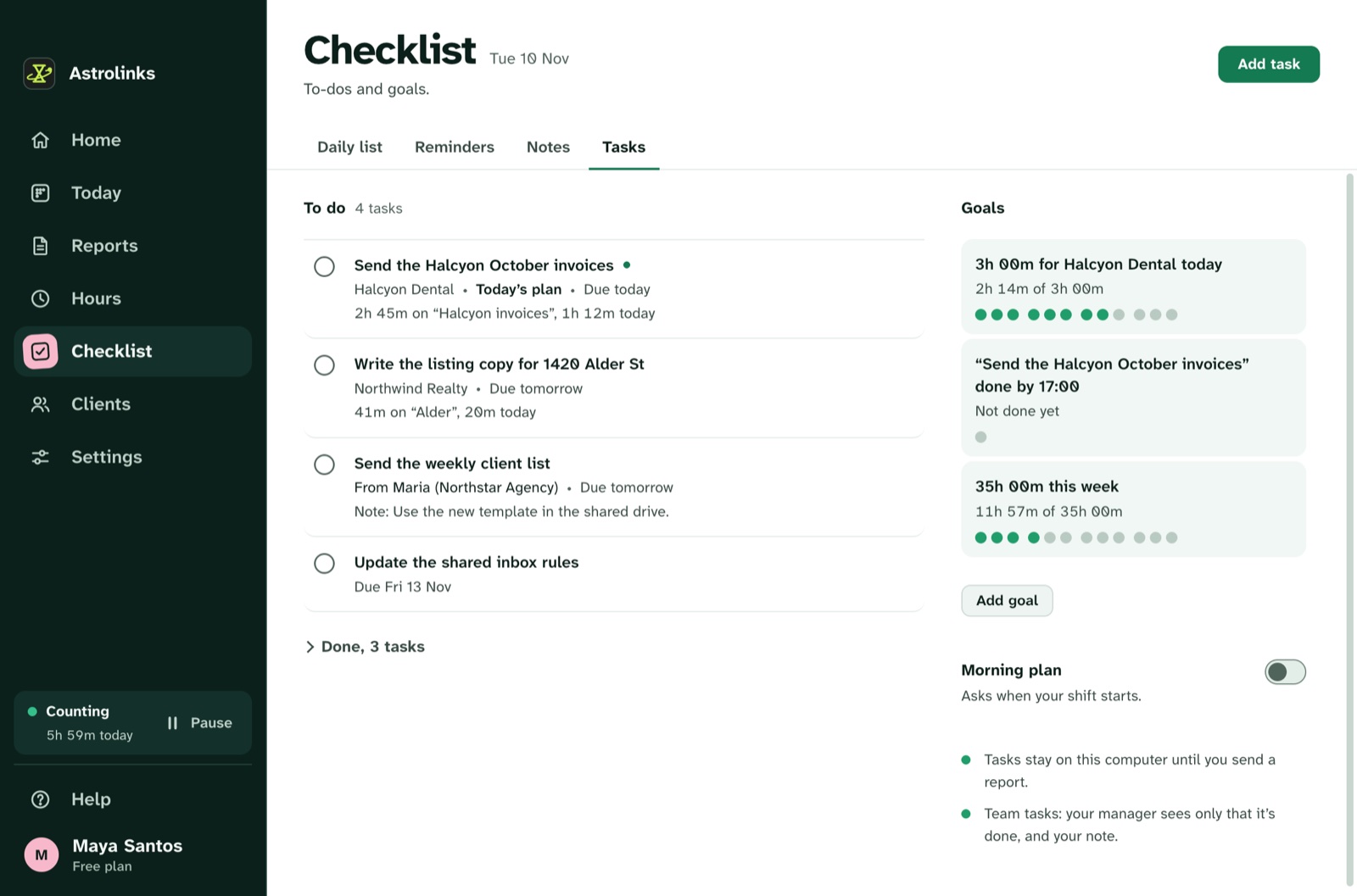
The morning plan in Checklist covers the standup side, if you want it: it asks for your plan when your shift starts. Quick notes help too. Press ⌃⌥N (Ctrl+Alt+N on Windows), type "blocked: staging logs access", and it lands under Blockers. On a team plan, the company sees only the reports each person chooses to send, never their activity. Developers can read more on the Astrolinks for developers page, and the end-of-day reports feature covers all the sending options.