 Astrolinks

Short answer
COB means close of business: the end of the business day, usually 5 p.m. local time for the person or office that set the deadline. By COB means before then, not midnight. COB is a firmer deadline than EOD, but neither names a time zone, so write the exact time and zone when it matters.
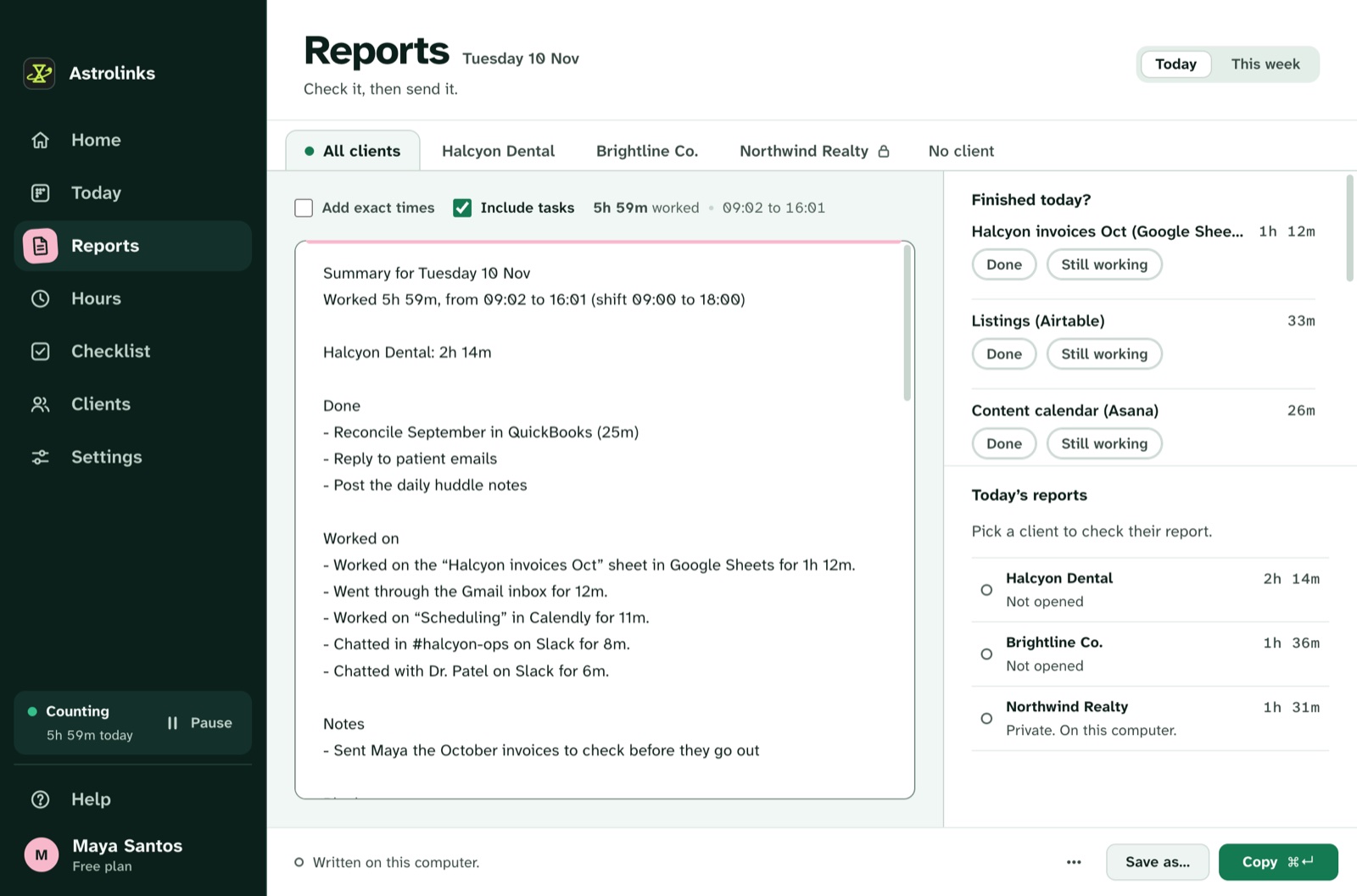
Want your EOD report written for you? Astrolinks writes it from your actual workday when you clock out. Get it free →
COB means close of business: the end of the business day, usually 5 p.m. in the time zone of the person or office that set the deadline. So the COB meaning at work is simple: "by COB" means before the office closes today, not before midnight.
The trouble starts when the sender and the reader work in different places. This guide covers what time COB really is, whose time zone counts, how COB compares with EOD, EOB and EOW, what COB means in banking and finance, and how to phrase a deadline nobody can misread.
What does COB mean?
COB stands for close of business. It's the point when an office's working day ends and people stop taking new work. In email and chat it works as a deadline:
- "Please send the signed contract by COB."
- "We need your numbers by COB Thursday."
- "Can you confirm by COB tomorrow?"
British offices sometimes say COP, close of play, which means the same thing. You'll also see EOB, end of business, which is just another name for COB.
COB can stand for other things outside work, but in a message about a task or a deadline, it means close of business.
What time is COB?
Most people read COB as 5 p.m. local time on a working day. Some offices close at 5:30 or 6 p.m., and some banks and government offices close earlier. There is no official definition, so COB means "when this office's day ends," whatever time that is.
What COB almost never means is midnight. That's the main difference from EOD, which some people stretch into the evening. If someone asks for a document by COB and you send it at 10 p.m., you have probably missed the deadline, even though it's still the same date.
Whose time zone does COB use?
Because COB refers to a business closing, it's tied to a place. The usual reading is the time zone of the person or office that set the deadline, since they're the one waiting for the work.
Here's how that plays out. A client in London asks a freelancer in Austin, Texas, for a file "by COB Friday." In winter, 5 p.m. in London is 11 a.m. in Austin. If the freelancer reads COB as their own 5 p.m., the file lands six hours late, at 11 p.m. London time, long after the client has gone home.
The gap also moves during the year. The US and the UK switch to and from daylight saving time on different dates, so for a few weeks in spring and autumn the difference is an hour smaller than usual. If you work across zones, check the current offset instead of relying on memory. Our guide to time zone etiquette for remote freelancers covers this in more depth.
COB vs EOD vs EOB vs EOW: what's the difference?
These terms overlap, and plenty of people use them interchangeably. Here's how they're usually read:
| Term | Stands for | Usual deadline | Where you see it |
|---|---|---|---|
| COB | Close of business | About 5 p.m., the office's local time | Finance, government, formal email |
| EOB | End of business | Same as COB | Formal email |
| COP | Close of play | Same as COB | British offices |
| EOD | End of day | End of the asker's workday, sometimes midnight | Everyday work chat and texts |
| EOW | End of week | End of the last workday of the week, usually Friday | Weekly deliverables |
| EOM | End of month | Last business day of the month | Reporting, accounting, invoices |
COB vs EOD
If you're searching for "cob vs eod" or "eod vs cob," the short answer is that they usually mean the same deadline, with one difference in tone. COB is tied to office hours, so it reads as firm: done before the office closes. EOD is looser. To some people it means 5 p.m., to others it means "before I go to bed." For more on EOD, see our full guide to EOD meaning.
A practical rule: if you receive "by EOD," aim for the end of the asker's workday anyway. If you receive "by COB," don't plan on stretching it.
EOB and EOW
EOB means the same as COB. EOW, end of week, usually means COB on the last workday of the week, so Friday afternoon in most offices. And EOM, end of month, usually means COB on the last business day of the month.
What does COB mean in banking and finance?
In banking and finance, COB is used more precisely than in everyday email.
- The business day. For a bank, COB is the end of its business day. Weekends and public holidays are not business days, so a payment sent on Saturday is normally treated as received on Monday.
- Cut-off times. Banks set cut-off times for different kinds of payments, and those are often earlier than the time the branch or office closes. A transfer submitted after the cut-off is usually processed on the next business day. Cut-off times vary by bank and by payment type, so check your own bank's.
- "As of COB." In finance reports, "positions as of COB" or "COB prices" means the figures as they stood at the close of that business day. A report dated Tuesday morning will often show Monday's COB numbers.
- Contracts. Many contracts define what a business day is, and some define close of business as a specific time in a specific city. When a contract defines it, that definition is the one that counts, not the everyday reading.
Examples of good deadline phrasing
COB is useful shorthand, but a deadline is only clear if both people would put the same time on it. Here's how to turn vague requests into clear ones:
| Vague | Clear |
|---|---|
| By COB | By 5 p.m. ET today |
| COB Friday | By 5 p.m. London time, Friday |
| COB tomorrow, your time | By 6 p.m. Manila time tomorrow (5 a.m. ET in winter) |
| ASAP, COB at the latest | Ideally by noon ET, no later than 5 p.m. ET |
| COB on the 30th | By 5 p.m. ET Monday, November 30 |
Three habits make the difference:
- Write the time and the zone. "5 p.m. ET" can't be misread. "COB" can.
- Add the weekday to a date. "Monday, November 30" catches mistakes that "the 30th" hides.
- Confirm when you accept. "Got it, you'll have it by 5 p.m. your time Friday" turns a vague deadline into a shared one.
How do you reply to a COB request?
If you can meet it, confirm in one line and restate the time: "Will do, by 5 p.m. your time." If you can't, say so early and offer a real alternative: "I can get you the draft by COB and the final version by 10 a.m. tomorrow. Does that work?"
What doesn't work is silence until 4:55 p.m. A note at lunchtime saying the work will slip gives the other person time to plan around it.
Is it OK to use COB in an email?
Yes. COB is standard business shorthand, and most office workers know it. It can confuse people outside office jobs, or people who learned English in a different business culture, so with a new client it's worth writing "by close of business" in full, or simply giving a time.
COB and your daily report
For many remote workers, the most regular COB deadline is the daily update itself: the note to a client or manager that says what got done today. If that's your situation, Astrolinks can help. It keeps a private log of your workday on your own computer, with no screenshots and no keystroke logging, and at clock-out it writes each client's end-of-day report from that log, with times shown on the client's clock if you like. You read it, edit it and send it. See how end-of-day reports work.