 Astrolinks


Short answer
To set goals as a freelancer, start with a yearly income goal that covers taxes and costs, then divide it by your hourly rate and your working weeks to get the billable hours you need each week. Add goals for time, clients and growth, make each one specific and checkable, and review them weekly and each quarter.
Astrolinks sorts your day by client without a timer and turns the hours into client updates and invoices. Get it free →
When you work for yourself, nobody sets targets for you. That's freedom, and it's also a trap. Without goals, the work fills whatever space it's given, and a year goes by in a blur of client emails. Learning how to set goals as a freelancer isn't about big vision boards. It's about a few clear numbers, a plan for each week, and a short habit of checking them.
This guide gives you the four kinds of goals worth setting, a step-by-step way to turn an income number into a weekly plan, templates you can copy, and a review routine that takes fifteen minutes.
What kinds of goals should a freelancer set?
Most useful freelance goals fall into four groups: income, time, clients and growth. You need at least one from each, because they keep each other honest.
1. Income goals
How much you want to earn in a year, a quarter or a month. This is the anchor. Everything else follows from it. Write it as the amount you bill, then check what's left after taxes and business costs.
2. Time goals
How many hours you want to work, and how many of those should be billable. Time is what you sell, so it needs a limit as much as a target.
3. Client goals
The mix of clients you want. How many? Which kinds? How much of your income from the biggest one? Relying on one client for most of your income is a risk worth naming.
4. Growth goals
Skills to learn, rates to raise, services to add. These are the goals that make next year easier than this one.
How do you set goals as a freelancer?
Work backwards from an income goal, check the hours are realistic, then turn yearly goals into specific weekly ones you check every Friday.
Step 1: Start from income and work backwards
Pick a yearly income goal. Then divide.
Illustrative example: a yearly goal of 36,000 USD at a rate of 30 USD an hour means 1,200 billable hours. Over 46 working weeks, that's about 26 billable hours a week.
That number is far more useful than "earn more". You can check it every Friday.
Why 46 weeks and not 52? Because you will take holidays, get sick, and have slow weeks between projects. Pick your own number of working weeks, but never assume 52.
Step 2: Remember taxes and costs
In the US, freelancers pay self-employment tax on top of income tax, and nobody holds it back from your payments. Software, equipment, health insurance and retirement savings all come out of what you bill too.
So set two numbers:
- Billed income: what you invoice.
- Take-home income: what's left after taxes and costs.
If your take-home goal is the one that matters to you, work backwards from that first, then add taxes and costs to get the billed income goal. A tax professional can tell you what share to set aside. Then use the billed number in Step 1.
Step 3: Check the hours are realistic
Billable hours aren't your only hours. You also spend time on email, invoicing, finding clients and learning. Many freelancers find that only part of their working week is billable.
A quick way to check: for two weeks, track every working hour, billable or not. Then work out the share that was billable. If 26 billable hours turns out to mean a 45-hour week, decide whether that's what you want. If not, the answer is a higher rate or a lower income goal, not more hours.
Here's how the same income goal looks at different rates:
| Yearly billed goal | Rate per hour | Billable hours a year | Per week (46 weeks) |
|---|---|---|---|
| 36,000 USD | 30 USD | 1,200 | about 26 |
| 36,000 USD | 40 USD | 900 | about 20 |
| 36,000 USD | 50 USD | 720 | about 16 |
A rate goal is often the fastest way to make an income goal fit a sane week.
Step 4: Turn yearly goals into weekly ones
Yearly goals are too far away to feel urgent. Weekly ones aren't.
| Yearly goal | Weekly version |
|---|---|
| 36,000 USD income | 26 billable hours |
| Raise my rate to 35 USD | Pitch the new rate to one new client |
| No client over 40% of income | Spend 2 hours on outreach |
| Learn Webflow | 1 hour of practice |
Each weekly version is something you control. You can't make a client say yes this week, but you can send the pitch.
Step 5: Make goals specific and checkable
Compare:
- Bad: "Work on my portfolio."
- Good: "Add two case studies to my portfolio by October 31."
- Bad: "Find better clients."
- Good: "Send five tailored pitches to agencies this month."
- Bad: "Stop working so much."
- Good: "No client work after 6 PM on weekdays, and none on Sundays."
A good goal lets you say yes or no on the deadline. Did it happen?
Step 6: Pick a weekly check-in time
Fifteen minutes on Friday afternoon. Look at:
- Billable hours this week, against your target
- Hours per client, to see if one is growing too big
- Your one or two weekly goals: done or not?
- Next week's goals
That's it. The habit matters more than the format.

A goal sheet you can copy
Keep your goals on one page. Paste this into a note or a document and fill it in once a quarter.
FREELANCE GOALS: [Quarter, Year]

Income
  Billed this quarter:        [amount]
  Rate:                       [amount] an hour
  Billable hours needed:      [hours] a quarter = [hours] a week

Time
  Most hours I'll work a week: [hours]
  Days off:                    [days]
  Weeks off this quarter:      [dates]

Clients
  Number of clients I want:   [number]
  Biggest client's share:     no more than [percent]
  One new client by:          [date]

Growth
  Skill or service:           [what], [hours] a week
  Rate change:                [new rate] for new clients from [date]
And a weekly check that fits on a sticky note:
WEEK OF [date]
Billable hours: [actual] / [target]
Biggest client this week: [name], [hours]
Last week's goals: [done / not done, and why]
This week's 1 or 2 goals:
  1. [goal]
  2. [goal]
Which goals protect freelancers from burnout?
Limits do: a maximum weekly hours number, a minimum rate, a response-time boundary, regular breaks and a cash buffer. Freelancers burn out more from too much work than too little. Some goals should be limits:
- A maximum weekly hours number. And a day off you don't trade away.
- A minimum rate. Work below it only on purpose, like a project you want for your portfolio.
- A response-time boundary. "I reply within one working day" is a goal too.
- Regular breaks. It's easy to work three hours straight without noticing.
- A cash buffer. A goal like "keep three months of costs in savings" makes slow months less frightening and makes it easier to say no to bad work.
Write limits next to your targets, not on a separate list. When they sit side by side, you notice when a target is pushing past a limit.
Example: one freelancer's quarter
This is an illustrative example.
Ana is a freelance bookkeeper. Her goals for October to December:
- Income: 9,000 USD for the quarter, which at 28 USD an hour means about 25 billable hours a week.
- Limit: no more than 38 working hours a week, and Sundays off.
- Clients: add one new client so her largest stops being half her income.
- Growth: raise her rate to 32 USD for new clients from January.
Each Friday she checks her billable hours against 25, looks at hours per client, and sets one small goal for the next week, like "send two pitches" or "write the new rate into my proposal template". In week six she notices her biggest client crept up to 22 hours. She doesn't drop them. She just moves the outreach goal up the list.
By the end of December she has a clear picture of what worked, which makes the next quarter's goals easier to set.
What should you ask in a quarterly goal review?
Ask whether you hit your income goal, how much of your time was billable, which clients paid best, and whether you stayed inside your limits. Weekly checks keep you on track. A quarterly review tells you whether the track is right. Block an hour and answer these:
- Did I hit my income goal? If not, was it fewer hours, a lower rate, or unpaid invoices?
- What share of my hours was billable? Is it going up or down?
- Which client paid best for the time it took? And which paid worst?
- Which goal did I keep skipping? Either it matters and needs a fixed slot, or it doesn't and should go.
- Did I stay inside my limits? Count the weeks you went over.
- What will I change next quarter? One or two changes, not ten.
Then rewrite the goal sheet. Keep what worked, adjust what didn't, and drop anything you've stopped caring about.
What goal-setting mistakes do freelancers make?
The most common are setting too many goals, setting only income goals, and never checking them.
- Too many goals. Five yearly goals is plenty.
- Only income goals. Without time limits, income goals drift into overwork.
- Never checking. A goal you don't look at isn't a goal.
- Guessing the hours. If you don't track time, you can't tell if you hit an hours goal. Our guide on how to track time across multiple clients helps here.
- Forgetting unpaid invoices. Billed isn't paid. Check what came in, not just what went out. See how to invoice hourly clients for a process that gets you paid on time.
- Copying someone else's numbers. Another freelancer's rate or hours tell you little about your costs, your market or the life you want.
How Astrolinks helps with freelance goals
Goals need numbers, and numbers need tracking you'll actually keep up. Astrolinks is a desktop app for Mac and Windows that keeps a private log of your workday on your own computer, sorted by client, so you get those numbers without starting timers.
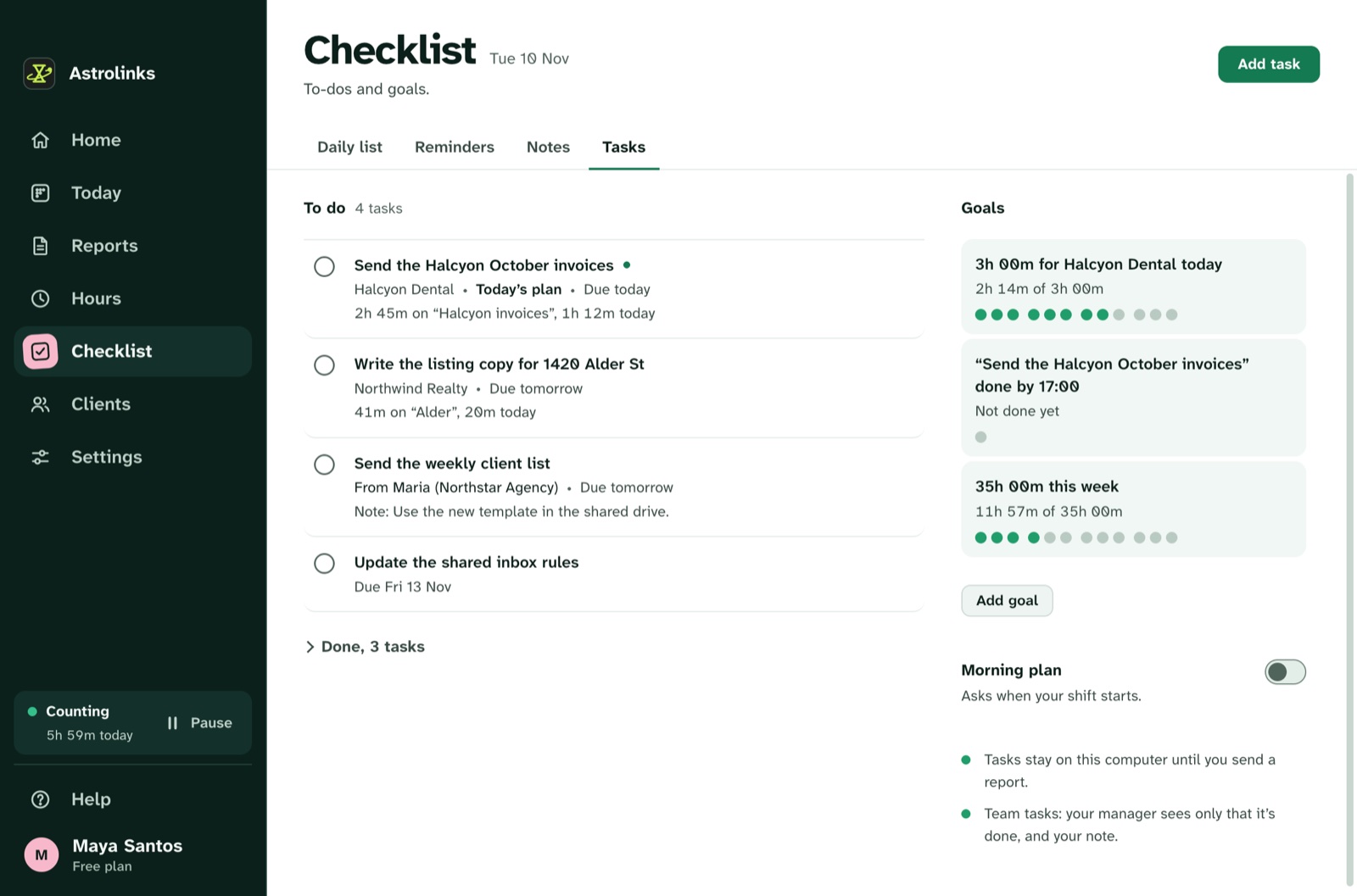
On the Checklist page, the Tasks tab lets you set goals as hours a day or a week, for one client or all of them, or as a task done by a certain time. Each goal fills in as you work. A task can have a keyword, and Astrolinks counts the time you spend on any window whose title or web address has it. Tasks and goals are on every plan, Free included. There's an optional morning plan that asks what you're working on at the start of your shift.
For your income check, Hours shows each client's hours and amounts. See the tasks and goals feature, or the Astrolinks for freelancers page for a typical week.