 Astrolinks


Short answer
To get clients as a virtual assistant, pick one niche and a one-sentence offer, build a profile that shows proof, then apply daily on job platforms, join communities where clients gather and message small businesses directly. Answer each job post in your first two lines, avoid scams, and keep clients with clear daily reports.
Astrolinks writes each client’s end-of-day update from your actual work, so 6 pm isn’t report time. Get it free →
Most advice on how to get clients as a virtual assistant comes from people selling a course or running an agency. This guide is neither. It's a plain 30-day plan for new and growing VAs, including the many in the Philippines who work for clients in the US, the UK and Australia. It covers picking a niche, building a profile that gets replies, where to look, what to send, how to handle the first call, and the part most guides skip: keeping clients long enough that they send you more.
You'll need about two focused hours a day and the patience to send many short, good messages.
Why should a virtual assistant pick a niche?
A niche shows a client at a glance whether you can help them, because "Virtual Assistant" on its own tells a client almost nothing. It's the label on thousands of profiles, and a busy business owner can't tell from it whether you can help them this week.
A niche headline does the sorting for them:
- "Inbox and calendar VA for real estate agents"
- "Shopify support VA for small stores"
- "Bookkeeping admin VA for solo accountants"
Pick one using three questions. What have you already done, at a job or for family or a small business? What do you enjoy enough to do every day? And which kind of business clearly needs it and can pay for it? You can change it later; picking one now shapes every message you send.
Then write your offer in one sentence: who you help, with what, and the result. For example: "I help real estate agents keep their inbox at zero and their showings booked, so they spend the day with buyers." That sentence goes at the top of every profile and outreach message.
Build a profile that gets replies
Clients skim. Your profile must show what you do, who for, and proof.
Headline. Your niche headline from above, word for word.
Short intro. Three or four sentences. Who you help, the tasks you take on, your working hours in the client's time zone, and how you keep them updated. Write to the client, using "you" more than "I".
Three proof points. Specific beats impressive. "Managed the inbox for a family business, about 80 emails a day, for two years" is stronger than "excellent communication skills". If you're new, use practice work and past jobs outside VA work.
A 60-second intro video. Record it on your phone in good light. Say your name, your niche, two tasks you're great at and your hours in their time zone. It shows your English and that you're a real person.
A simple portfolio. Three samples are enough:
- A sample end-of-day report for an imaginary client, using our EOD report template for virtual assistants.
- An SOP you wrote, such as "How to schedule a property showing" with steps and screenshots.
- A before and after screenshot of an inbox you organized, with every name, email and private detail blurred.
Put them in a shared folder or a one-page document and link it everywhere.
Where can a virtual assistant find clients?
A virtual assistant can find clients in three places: job platforms, communities and direct outreach. Most VAs do best with two of them at once. Check each platform's current fees and rules before you start, since they change.
| Where | Examples | Good for | Watch out for |
|---|---|---|---|
| Job platforms | OnlineJobs.ph, Upwork, Fiverr, LinkedIn jobs | A steady flow of posted jobs, built-in contracts or payments on some | Lots of applicants per post, fees on some, rules about moving off the platform |
| Communities | Facebook groups for VAs and for business owners, LinkedIn | Warm leads, referrals, learning from other VAs | Scam posts, noise, slow results |
| Direct outreach | Small businesses in your niche | Less competition, clients who chose you | Takes research, many messages get no reply |
Job platforms are the usual start for a first client. OnlineJobs.ph is built around Filipino VAs and long-term roles. Upwork and Fiverr are global, with more competition and their own payment systems. LinkedIn jobs works best when your LinkedIn profile matches your niche.
Communities reward patience. Join groups where your target clients hang out, not only VA groups, and answer questions without pitching.
Direct outreach is how many VAs get direct clients. Pick 20 small businesses in your niche. Look for signs they're stretched: replies to reviews months late, an empty social feed, a "we're hiring" post for admin help.

Applications that stand out
Most replies to a job post open with "Dear Hiring Manager". Answer their post in the first two lines instead.
Hi [Name], you need someone to clear your inbox daily and book showings for [Business] during US Eastern mornings. I do exactly that for real estate agents, from 8 AM to 12 PM your time.
Three things that fit your post:
- [Proof point 1 that matches the job]
- [Proof point 2]
- [Proof point 3]
Here's a sample end-of-day report and a 60-second intro video: [link]. You'd get a report like that every day.
One question: [a smart question about their post]
[Your name]
The closing question shows you read the post and gives them an easy reason to reply.
For direct outreach, keep it even shorter:
Hi [Name], I noticed [Business] has [specific sign, such as several unanswered reviews from last month]. I'm a VA who helps [niche] keep [the task] up to date, so it doesn't eat your evenings.
Would it help if I did a free 20-minute cleanup of [a small, safe piece] so you can see how I work? No commitment.
[Your name], [link to your portfolio]
If there's no reply after four or five days, follow up once, then stop:
Hi [Name], just bringing this back to the top of your inbox. If now isn't a good time for help with [task], no problem at all. I'll leave my portfolio here in case it's useful later: [link].
Track every message in a simple sheet: business, date sent, follow-up date, reply.
The trial task and the first call
Many clients ask for a test task. That's normal. A few rules keep it fair:
- Short tests can be free. Thirty minutes or so is reasonable.
- Longer tests should be paid. If it's a full day of real work for their business, say kindly that you're glad to do it at your hourly rate.
- Get a clear scope in writing. What to do, what tools, what "done" looks like and the deadline.
- Over-communicate. Send a short update when you start and a short report when you finish. The report often wins the job more than the task itself.
On the first call, ask questions:
- Which tools do you use for email, calendar, files and chat?
- What hours should I work, and in which time zone?
- What's the most annoying task on your plate right now?
- How do you want updates: a daily report, a weekly recap, Slack or email?
- Who do I ask when I'm stuck, and how fast do you usually reply?
- How will we track hours and handle invoices?
These answers become your client sheet, covered in how to manage multiple clients as a VA.
How much should a beginner virtual assistant charge?
There's no single right number: base your rate on your hours, skills, niche and proof. Here's how to decide:
- Hours. How many hours a week can you give this client, reliably, at the time they need?
- Skills. Basic admin is priced differently from Shopify support or bookkeeping admin. Specialist work pays more.
- Niche. Look at what similar job posts in your niche offer, on more than one platform.
- Proof. With no testimonials, start at a fair rate you can live with. After two or three good months and a few testimonials, raise it for new clients, then for current ones with notice.
Always quote in the client's currency, such as US dollars, pounds or Australian dollars, so they don't have to convert. State whether the rate is hourly or a monthly retainer, and how many hours that covers.
How do you spot virtual assistant job scams?
Watch for anyone who asks you to pay upfront, deposit a check, leave a platform early or share your bank login. VA work attracts scammers because many people want remote jobs. Walk away when someone:
- Asks you to pay for training, a starter kit, software or equipment before you start.
- Sends you a check to deposit and asks you to forward part of the money or buy something.
- Wants to move off a platform before any contract or payment, especially in the first message.
- Asks for your bank login, your one-time codes, or your government ID before a real contract.
- Offers high pay for very little work, with a vague job description and pressure to decide today.
When in doubt, ask in a VA community you trust before you reply.
Keep clients so you need fewer new ones
Every client you keep is one you don't have to find again. Most clients don't leave because a VA made one mistake. They leave because they stopped knowing what was happening.
Send a clear end-of-day report every day. What you finished, what's in progress, what's blocked and what's next. Outcomes, not activity. If you work a night shift, time it so it's waiting when they wake up; our guide to night shift VA client updates shows how.
Flag blockers early. "I can't finish the invoice batch until you share the new price list" sent at 10 AM saves a frustrated message at 5 PM.
Send a weekly recap. Main results, hours used, anything still open, and the plan for next week. Our weekly client recap templates give you formats to copy.
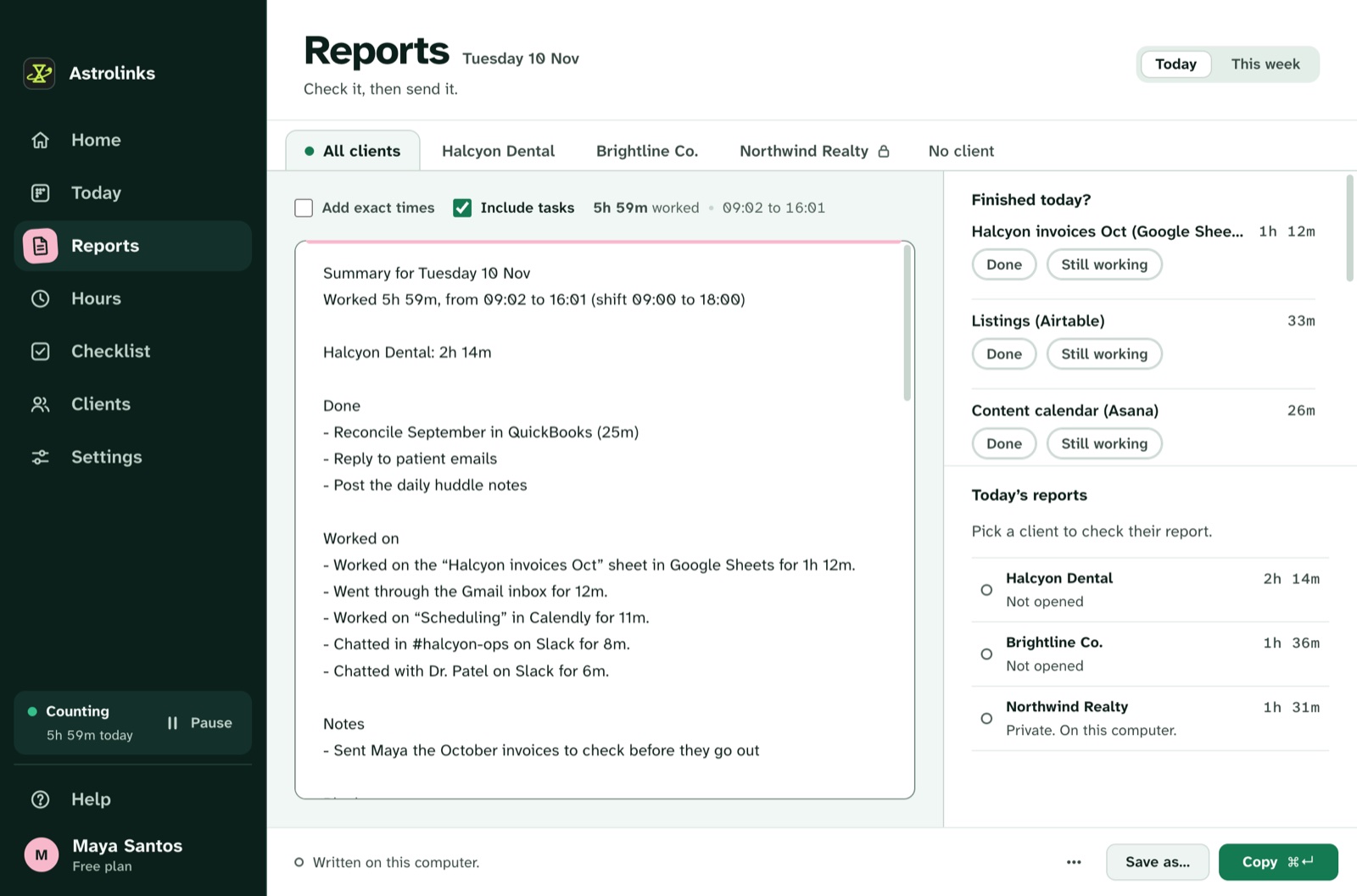
Daily reports are the habit that slips first when you're busy. Astrolinks is one way to keep it quick. It's a desktop app for Mac and Windows that keeps a private log of your workday on your own computer (no screenshots, no keystroke logging, nothing sent anywhere), sorts your hours by client, and at clock-out drafts an end-of-day report for each client, in their time zone and language. You read it, edit it and send it. If a client asks how you track time, our post on time tracking without screenshots explains the difference.
Ask for a testimonial and a referral after a good month. Wait until the client has said something kind, then ask:
Hi [Name], I've really enjoyed this first month working on [Business]. Two small asks, only if you're happy with my work: would you write two or three sentences about working with me that I can share on my profile? And if you know another [niche] who could use help with [task], I'd be grateful for an introduction. Thank you either way.
Good clients often know others like them.
Your 30-day checklist
| Week | What to do |
|---|---|
| Week 1 | Pick your niche and write your one-sentence offer. Write your headline, intro and three proof points. Make three portfolio samples. Record your 60-second video. |
| Week 2 | Set up profiles on two job platforms and update LinkedIn. Join three communities where your clients spend time. Apply to three to five matching jobs a day with the proposal template. |
| Week 3 | Keep applying daily. Send five direct outreach messages a day and follow up once after four or five days. Track every message in a sheet. Do test tasks with a clear scope. |
| Week 4 | Take first calls with your question list. Set your rate in the client's currency. Start your first client with daily reports and a Friday recap. Keep a light pipeline of applications going. |
You can see how Astrolinks fits a VA's day on the Astrolinks for virtual assistants page, and try it with 7 days of Pro, no card.