 Astrolinks

Short answer
EOW means end of week. At work, by EOW usually means by the end of the last workday of the week, which is Friday at about 5 p.m. in most offices, not Sunday night. It uses the asker's working week and time zone, so when the deadline matters, write the day, time and zone.
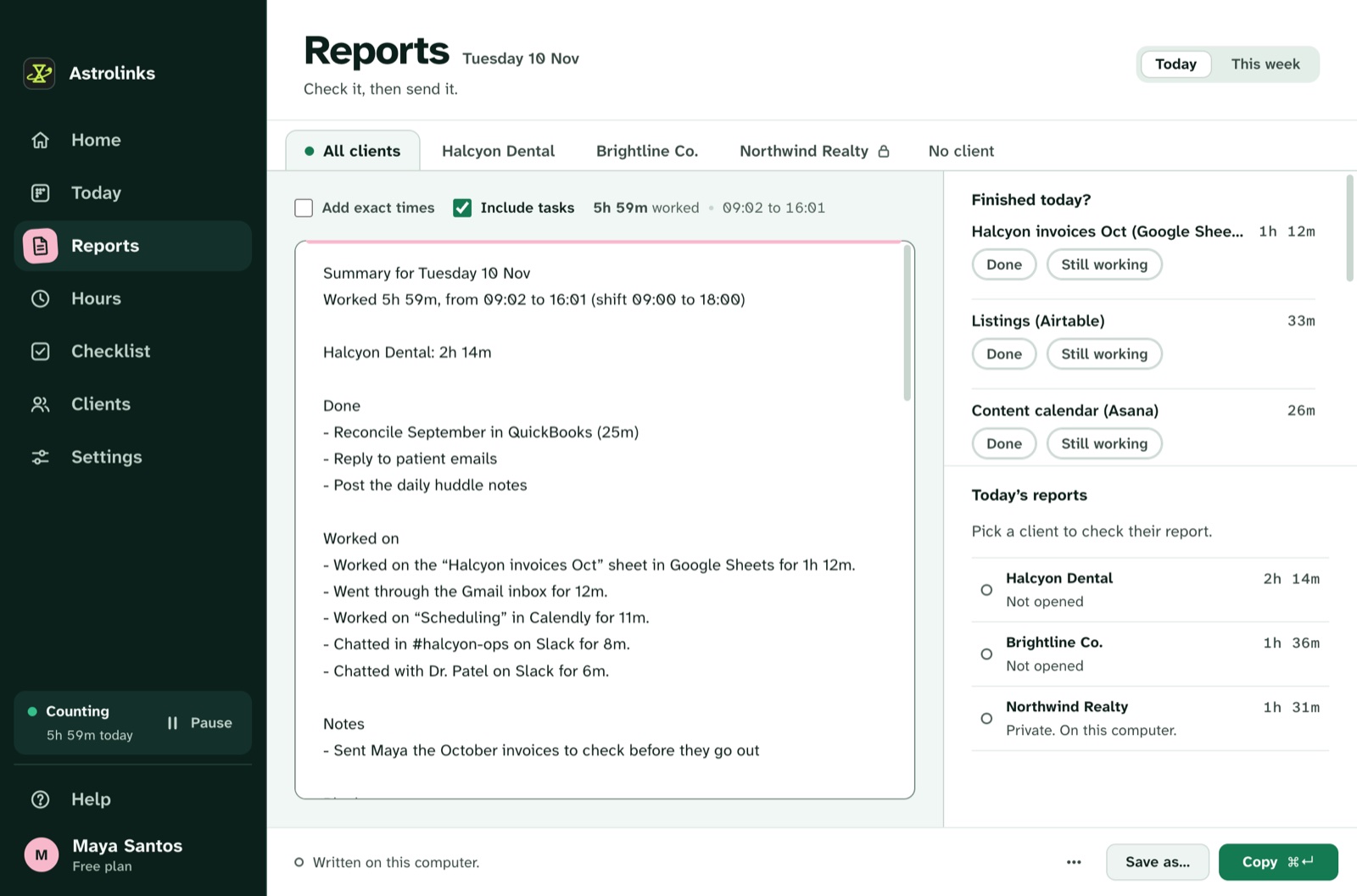
Want your EOD report written for you? Astrolinks writes it from your actual workday when you clock out. Get it free →
EOW means end of week: at work, "by EOW" usually means by the end of Friday's workday, around 5 p.m. in the asker's time zone. That's the common EOW meaning in most offices. It doesn't usually mean Sunday night, and it doesn't mean "sometime next week."
This guide covers which day and time EOW is, how EOW compares with EOD and EOM, how time zones change it, and how to phrase a weekly deadline so nobody has to guess.
What does EOW mean?
EOW stands for end of week. You'll see it in emails, project tools and chat:
- "Can you get me the draft by EOW?"
- "Final numbers EOW, please."
- "I'll have the designs to you EOW."
Like EOD, it's a soft deadline: it gives a window, not an exact time. That's handy when the exact time doesn't matter much, and a problem when it does.
You may also see EOTW (end of the week) or EOWK. They mean the same thing.
Which day is EOW?
In most workplaces, EOW means Friday. More precisely, it means the last day of the asker's working week. A few cases where that's not Friday:
- Different working weeks. In some countries, such as Saudi Arabia, the working week runs Sunday to Thursday, so EOW means Thursday.
- Holiday weeks. If Friday is a public holiday, many people read EOW as the last working day before it. Others still mean Friday. A one-line question settles it.
- Part-time and shift schedules. If the person asking only works Monday to Wednesday, their week ends on Wednesday.
- Weekend workers. Some freelancers and small business owners do read EOW as Sunday night. That's rare in office settings, but worth knowing.
What time is EOW?
Usually the end of the workday on that last day, so around 5 p.m. Friday. In other words, EOW is EOD on Friday, or COB Friday if you want the firmer version. (See COB meaning for how close of business differs from end of day.)
Sending something at 11 p.m. Friday technically lands inside the week, but the person who asked has probably stopped for the weekend and was hoping to see it before they left.
EOW vs EOD vs EOM and others
Here is a quick reference for the "end of" family:
| Term | Stands for | Usual deadline |
|---|---|---|
| EOD | End of day | End of today's workday, about 5 p.m. |
| COB | Close of business | When the office closes today, about 5 p.m. |
| EOW | End of week | End of the last workday of the week, usually Friday |
| EOM | End of month | End of the last business day of the month |
| EOQ | End of quarter | Last business day of the quarter |
| EOY | End of year | Last business day of the year, often before the holidays |
| NLT | No later than | A hard cutoff, as in "NLT Friday 3 p.m." |
EOW vs EOD
EOD is today. EOW is the end of the week. On a Friday, EOD and EOW point to the same moment. On a Tuesday, "EOD" means tonight and "EOW" gives you until Friday.
EOW vs EOM
EOM means end of month, usually the last business day of the month. When the last day of the month falls midweek, EOM can come before EOW. "Due EOM" in a week that ends on the 2nd means the 30th or 31st, not Friday.
How do time zones change EOW?
EOW uses the asker's week and the asker's clock. When you work across time zones, Friday afternoon in one place can be Friday night, Saturday morning or Friday breakfast somewhere else.
Here is what Friday at 5 p.m. in New York looks like elsewhere during US winter time, from early November to early March:
| City | Friday 5 p.m. New York (EST) is |
|---|---|
| Los Angeles | Friday 2 p.m. |
| London | Friday 10 p.m. |
| Manila | Saturday 6 a.m. |
| Sydney | Saturday 9 a.m. |
So a virtual assistant in Manila working for a New York client technically has until early Saturday morning, local time. In practice, that's not a deadline anyone should work to. The better plan is to deliver by the end of your own Friday, which still lands before the client's day starts, and say so: "You'll have it by Friday morning your time."
It works the other way too. If your client is in Sydney and you're in New York, their Friday 5 p.m. is your Friday 1 a.m. during the northern winter. Their EOW arrives before your Friday even starts, so plan to deliver on Thursday.
EOW examples, vague and clear
| Vague | Clear |
|---|---|
| By EOW | By 5 p.m. ET Friday |
| EOW is fine | Any time before you log off Friday works |
| EOW, my time | By Friday 5 p.m. London time (noon ET) |
| Sometime EOW | Thursday or Friday, whichever is easier |
| EOW, latest Monday | Ideally Friday, Monday 9 a.m. at the latest |
The habit that fixes most of it: when you accept an EOW request, reply with the actual time. "Sounds good, you'll have it Friday by 3 p.m. your time." Now both of you are working to the same deadline.
EOW and the weekly update
EOW shows up in another way at work: the end-of-week update. Many freelancers and remote workers send a short weekly recap on Friday afternoon covering what got done, what's open and what's planned for next week. If you need a format, our weekly client recap templates has five to copy.
The recap is far easier to write if you have the week's daily updates to read back through. Astrolinks keeps a private log of your workday on your own computer, with no screenshots and no keystroke logging, and writes each client's end-of-day report at clock-out. By Friday you have five days of reports to pull the recap from instead of a blank page. See how end-of-day reports work.
Is it rude to say EOW?
No. EOW is common workplace shorthand. It's a little less widely known than EOD or ASAP, though, so with a new client, or someone outside an office job, spell it out: "by the end of the week." And if you're the one asking, remember that "EOW" followed by a check-in on Wednesday will feel like the deadline moved.
Quick summary
- EOW means end of week.
- By EOW usually means by the end of Friday's workday, around 5 p.m.
- The asker's week and time zone decide it, so EOW can be Thursday in a Sunday-to-Thursday week.
- EOD on a Friday and EOW are usually the same moment.
- When it matters, write the day, time and zone.