 Astrolinks

Short answer
EOM usually means end of month. At work, by EOM means by the end of the last business day of the month. On invoices, EOM payment terms count from the end of the month the invoice is dated: net 30 EOM means payment is due 30 days after that month ends. In an email subject line, EOM can also mean end of message.
Want your EOD report written for you? Astrolinks writes it from your actual workday when you clock out. Get it free →
EOM usually means end of month: "by EOM" means by the end of the last business day of the month. That's the common EOM meaning at work. On invoices, EOM changes how payment terms are counted, and in an email subject line it can mean something else entirely: end of message.
This guide covers all three: EOM as a work deadline, EOM in accounting and invoice payment terms (including net EOM, net 30 EOM and 2/10 EOM), and EOM in email, with examples of each.
What does EOM mean at work?
At work, EOM is a deadline: "Can we have the report by EOM?" or "Budget requests are due EOM." It works like EOD and EOW, just over a longer window.
Most people mean the end of the last business day of the month, so around 5 p.m. local time. When the 31st falls on a Saturday, EOM in practice usually means Friday the 30th, because nobody will look at your report over the weekend. Some people do mean the calendar date, though, so when the gap matters, name the date.
Two things make EOM deadlines easy to miss:
- Months vary. February has 28 or 29 days, so "EOM" in February comes sooner than it feels.
- Month-end is busy. Finance teams, managers and clients are often closing their own books in the last few days, so an EOM deliverable that arrives at 5:59 p.m. on the last day may sit until the next week.
What does EOM mean in accounting?
In accounting, EOM refers to the month-end: the point at which a month's books are closed. You'll see it in phrases like:
- EOM balance: an account balance as of the last day of the month.
- Month-end close: the process of recording, checking and reconciling everything for the month so reports can be produced.
- EOM reporting: the reports that come out of that close, such as monthly profit and loss.
If you're a freelancer or contractor working with a client's finance team, this is why they may ask for your invoice or timesheet "by EOM." They want it in that month's books.
What does EOM mean on an invoice?
On an invoice, EOM appears in the payment terms, and it changes the date the payment clock starts. With ordinary terms such as net 30, you count from the invoice date. With EOM terms, you count from the end of the month the invoice is dated.
Here's how the common versions are usually read:
| Terms | Usual meaning | Invoice dated March 12 is due |
|---|---|---|
| Net 30 | 30 days after the invoice date | April 11 |
| Net EOM | By the end of the month the invoice is dated | March 31 |
| Net 10 EOM | 10 days after the end of the invoice month | April 10 |
| Net 30 EOM (also EOM 30) | 30 days after the end of the invoice month | April 30 |
| 2/10 EOM | 2% discount if paid within 10 days after month end | Discount until April 10 |
A few things to know before you put EOM on your own invoices:
- Net 30 EOM usually gives the customer longer to pay than net 30. An invoice dated March 1 under net 30 is due March 31. Under net 30 EOM, it's due April 30.
- Readings vary. EOM terms are an industry convention, not a single standard. Some businesses read "EOM" alone as due at the end of the following month, and some suppliers treat invoices dated in the last few days of a month as if they were dated the next month. If that's how a customer works, their purchasing terms should say so.
- Discount terms need a full due date too. "2/10 EOM" tells the customer when the discount ends. It doesn't, on its own, say when the full amount is due, so add that as well.
- Contracts win. If your contract or the customer's purchase order defines payment terms, those govern, whatever the usual reading is.
The safest habit is simple: print the actual due date on the invoice, next to the terms. "Terms: net 30 EOM. Due: April 30" can't be misread. Our freelance invoice template has a due date field for exactly this, and our guide on how to invoice hourly clients covers payment terms in more detail.
What does EOM mean in an email?
In an email subject line, EOM often means end of message. It tells the reader that everything they need is in the subject, so there's no need to open the email:
- "Running 10 minutes late to the 2 p.m. call EOM"
- "Invoice paid, thanks EOM"
- "Office closed Friday for the holiday EOM"
It's a small courtesy for busy inboxes. If EOM appears at the end of a subject line with nothing in the body, it means end of message, not end of month.
EOM quick reference
| Where you see it | EOM means | Example |
|---|---|---|
| A work deadline | End of the last business day of the month | "Send the report by EOM" |
| Accounting | Month-end, when the books are closed | "EOM balance" |
| Invoice terms | Payment period starts at the end of the invoice month | "Net 30 EOM" |
| Email subject line | End of message, nothing in the body | "Meeting moved to 3 p.m. EOM" |
| Retail and sales | End-of-month sale or quota | "EOM clearance" |
Examples of clear EOM deadlines
| Vague | Clear |
|---|---|
| By EOM | By 5 p.m. ET Monday, November 30 |
| EOM is fine | Any time before the last business day of the month |
| Invoice due EOM | Due November 30 |
| Net 30 EOM | Net 30 EOM, due December 30 (for a November invoice) |
Adding the weekday catches mistakes: November 30, 2026 is a Monday, so EOM and the start of a new week fall on the same day. When the last day of the month falls on a weekend, say which working day you mean.
How EOM fits with your daily and weekly updates
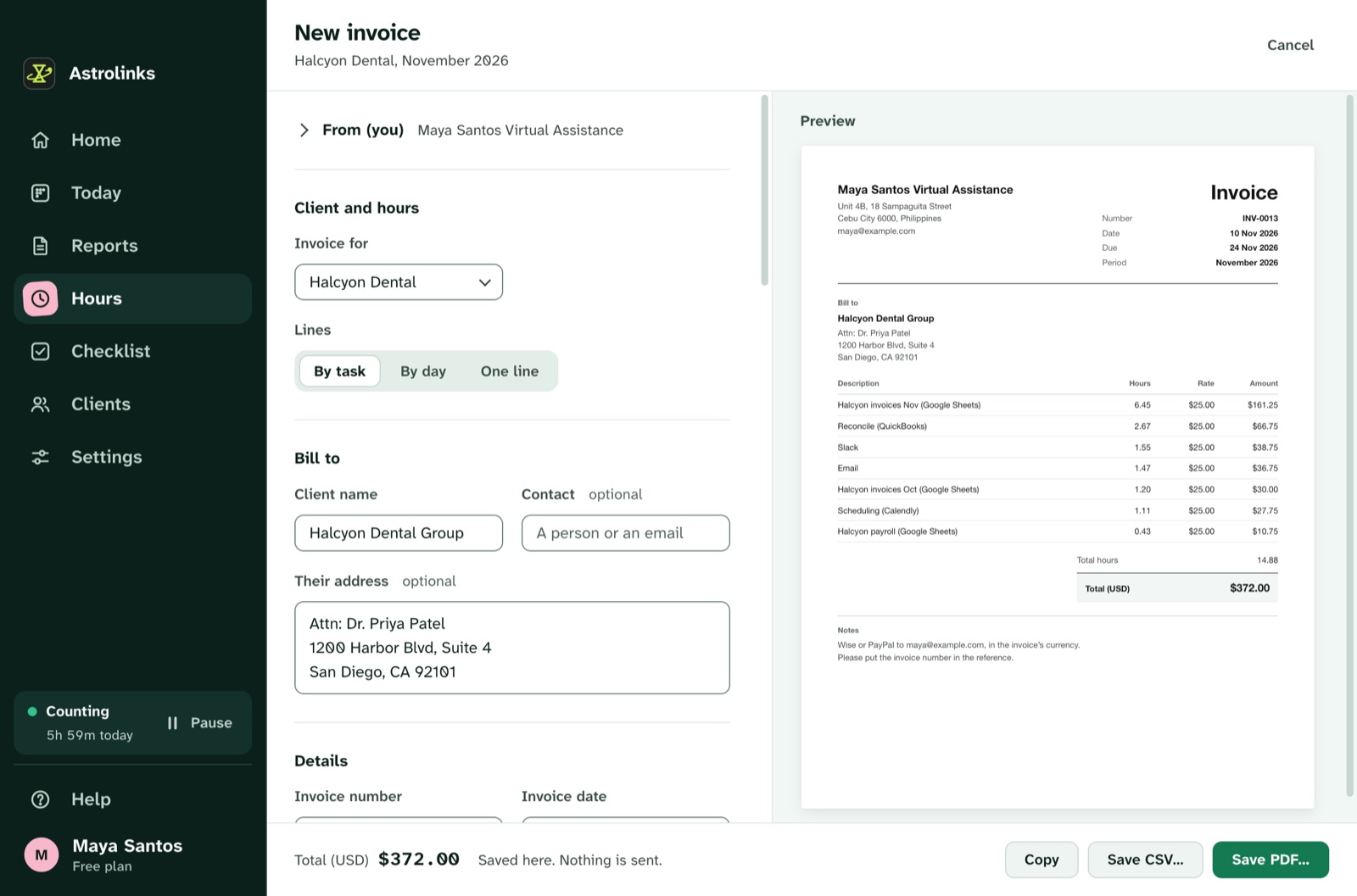
For many freelancers and remote workers, EOM is when the month's work turns into an invoice or a monthly summary for a client. That's easy when you have a record of each day, and painful when you're rebuilding the month from memory. Astrolinks keeps a private log of your workday on your own computer, with no screenshots and no keystroke logging, writes each client's end-of-day report at clock-out, and keeps hours per client that you can turn into a PDF invoice. You still choose the terms and the due date. See hours and invoices in Astrolinks.